Introduction
Anyone interested in the conflicts that have devastated the Great Lakes region of Africa, and the massacres committed during the Congo Wars, should ask themselves one crucial question: How were young recruits, often from marginalized communities such as the Banyamulenge, transformed into ruthless warriors?
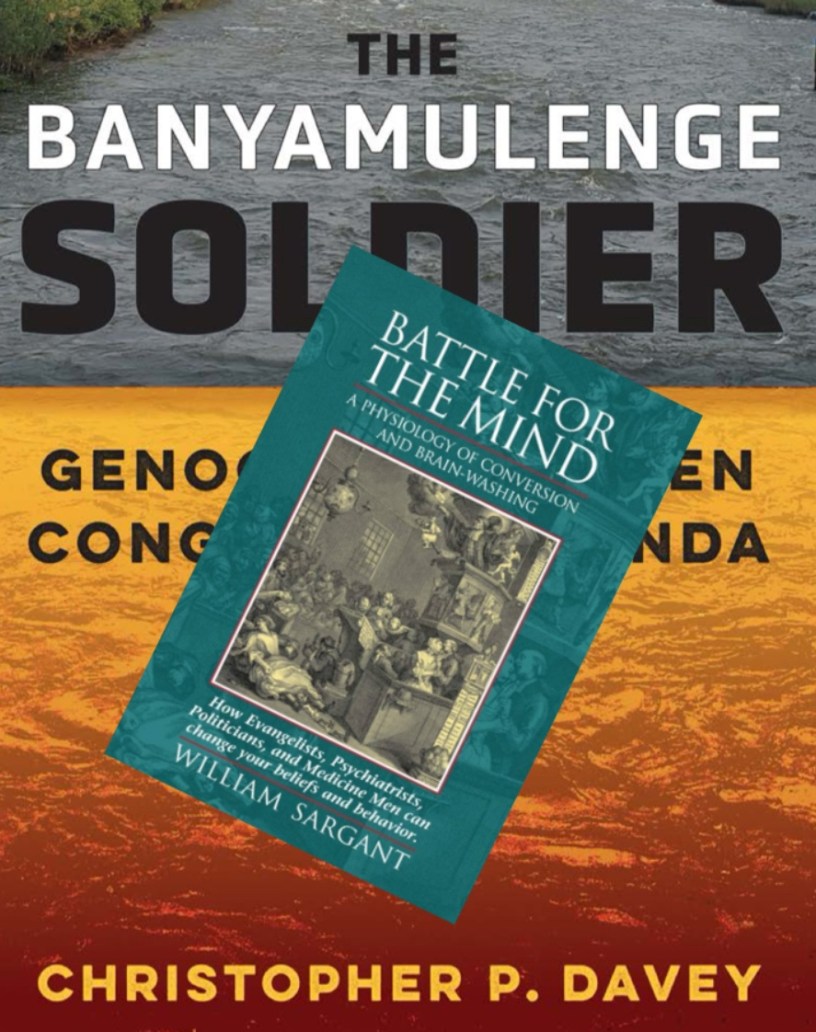
The book Banyamulenge Soldiers by Christopher P. Davey provides a striking insight into this process. It describes how the RPF (Rwandan Patriotic Front) used invasive and violent training methods to provoke psychological collapse and then reconstruct the identity and narrative bubble of these young men.
[Click to access Chapter III of the book]
Beyond learning military techniques and physical conditioning, this total takeover by the Rwandan army had a deeply ideological purpose: to implant in the recruits’ cognitive landscape an ultra-Manichean worldview opposing the “potential victim” to the “potential génocidaire.” The goal was to produce warrior behavior that would deliver geopolitical advantages to the Kigali regime.
To understand these mechanisms in depth, it is particularly valuable to cross-reference the life stories described in Davey’s book with the theories presented in William Sargant’s Battle for the Mind (1957). The British psychiatrist drew on Ivan Pavlov’s work with dogs to explain forced conversions and brainwashing.
Sargant describes how extreme physiological stress — hunger, deprivation, and violence — can erase existing mental patterns and make the individual receptive to new ideologies.
Applied to the context of Banyamulenge recruits and forces such as the AFDL (Alliance of Democratic Forces for the Liberation of Congo-Zaire), this framework explains the effectiveness of the ideological training administered through these techniques to “inseminate” a polarizing ideology that justifies violence as a preventive defense against an omnipresent enemy.
This article explores this transformation process, structuring the analysis around the key stages: recruitment and initial breakdown, exposure to violence and the creation of a dichotomous identity, the application of Sargant’s techniques, and the ideological and behavioral consequences.
Recruitment and the Initial Breakdown of Recruits
Banyamulenge recruits, often young men who had fled persecution in Congo or Rwanda, arrived at training centers after exhausting journeys and a voluntary enlistment driven by despair.
From the moment they were taken in charge, the transformation process began with a systematic “breaking” phase.
According to Davey, these centers did not limit themselves to classic military training; they aimed to deconstruct the individual identity in order to forge a new, collective, and warrior one.
The goal was precisely to pour new self-representation scripts into the individual’s narrative bubble and force identification between the “I” and this narrative self, generating a form of reification of the self.
The testimonies collected in the book are edifying: recruits endured daily humiliations, beatings with sticks or canes, and exhausting chores such as collecting firewood under strict deadlines, with severe punishment for any failure.
One recruit described: “We were beaten from morning till night, and it was only after that that our perceptions changed, as if we were no longer hungry and we looked for food differently.”
Many ended up in hospital, marking the beginning of a physical and mental vulnerability deliberately created and intended to be exploited.
This initial phase aligns with Sargant’s principle of transmarginal inhibition, inspired by Pavlov: prolonged stress exceeds the brain’s tolerance threshold, causing a rupture in habitual nervous patterns.
In Pavlov’s dogs, extreme floods or fevers erased previous conditioning; in humans, hunger, sleep deprivation, and mistreatment lower mental defenses, making the individual dependent and, above all, highly suggestible.
Exposure to Violence and the Construction of a “Us” vs. “Them” Identity
Once plunged into the desired state of psychological collapse, the recruits were exposed to horrors that served as an ideological catalyst.
For those who had lived through the Rwandan civil war or the 1994 genocide, this exposure was direct: they had seen emaciated and mutilated bodies and participated in violent social relations.
For the others, videos and stories were used to create trauma — a psychological shock capable of allowing the cognitive implantation of a new interpretation of the world.
At the heart of this transformation lies the creation of a radical dichotomy: the recruit came to see himself as a “potential victim” facing a “potential génocidaire.”
This category of the “potential génocidaire” was extended to the maximum. It covered not only those who had committed genocidal acts, but also anyone closely or remotely linked to such acts, or even those suspected of carrying a “genocidal ideology.”
To further expand the category of “potential génocidaires,” the notion of “genocidal ideology” itself was stretched to its limit.
Merely criticizing the official RPF narrative — without denying the reality of genocidal acts — was enough to place the critic in the category of potential génocidaires.
Innocuous behaviors were assimilated to this ideology, creating concentric circles of enemies.
As Davey explains, this generated a “heightened sense of vigilance,” in which every action was interpreted as a sign of a potential future genocide.
This narrative manipulation relied on expectations implanted during the recruits’ ideological training.
The perception of a permanent possibility of a future genocide justified an aggressive defensive posture and, at times, even “preventive” genocidal acts — as occurred during the First Congo War.
Sargant explained this mechanism as a “temporary reorganization” of the brain: after collapse under stress, new ideas — here, the potential victim / potential génocidaire dichotomy — are injected into the cognitive apparatus and anchored through repetition.
Application of Sargant’s Techniques: From Physiological Stress to Ideological Implantation
The methods described by Davey closely echo Sargant’s stages for inducing “experimental neurosis” through the following process:
- Prolonged Stress and Debilitation: Hunger, sleep deprivation, extreme fatigue, and physical violence (beatings, punitive chores) exhaust resources. Sargant notes that these factors “lower mental defenses” by altering cortical thresholds, as seen in Pavlov’s castrated or feverish dogs, where debilitation was necessary to fix new behaviors.
- Intense Emotional Excitation: Fear is amplified through speeches about the devil (analogous to religious conversions) or the genocidal hell, creating internal conflict. Rhythmic rituals or unpredictable interrogations prolong the tension until breakdown.
- Collapse and Suggestibility: Once the threshold is crossed, the individual becomes a “blank slate.” It is at this point that the ideology is “inseminated”: anti-colonialism blaming Western imperialism for the region’s ills, class liberation principles, and parallels with Israel (admiration for the Israeli Defense Forces and identification with Jews facing “génocidaires”).
- Consolidation: Rewards, constant narrative pressure, and historical narratives (the history of Rwandan kings, rejection of “Western” discourse) anchor this worldview. Recruits learn that “if you do not give your blood for the country, the dogs will drink it for free,” and see themselves as “Tutsi brothers” destined to return to a “lost paradise,” similar to Zionism. Any discourse contradicting the RPF’s narrative is necessarily false and intended to divide.
Thus, the so-called ideological training maximized obedience, enabling the commission of “preventive” massacres while limiting remorse — at least in the short term.
Consequences: Legitimization of Violence and Participation in Massacres
This Manichean ideology, which reifies identities as potential victims versus potential génocidaires, legitimizes the use of violence.
The enemy, as a potential génocidaire, deserves preventive extermination.
This explains the participation of Banyamulenge fighters in the massacres of Hutu refugees, including women, children, the elderly, and men alike.
As Davey notes, all conflicts were read through this identity grid, transforming ethnic or territorial disputes into existential struggles.
Sargant was right to warn that this mechanism — biological and universal — could serve manipulative ends, as in communist brainwashing or psychiatric therapies.
In the Rwandan-Congolese context, it produced obedient “killing machines,” but at the cost of a lasting polarization that perpetuates cycles of violence.
Conclusion
The transformation of Banyamulenge recruits illustrates how techniques of psychological breakdown, inspired by Sargant’s and Pavlov’s theories, serve to implant a destructive ideology.
By creating an insoluble dichotomy between potential victim and potential génocidaire, these methods do not merely train soldiers — they create ideological actors ready for anything.
This process, revealed by Davey, invites reflection on the universal mechanisms of mental manipulation in armed conflicts and on the need to deconstruct these narratives in order to break the chains of violence.

