Introduction
The perpetration of mass violence, whether during the 1994 Tutsi genocide in Rwanda or the massacres of Hutu refugees in the Democratic Republic of the Congo (DRC) in 1996–1997, is often attributed to extremist ideology.
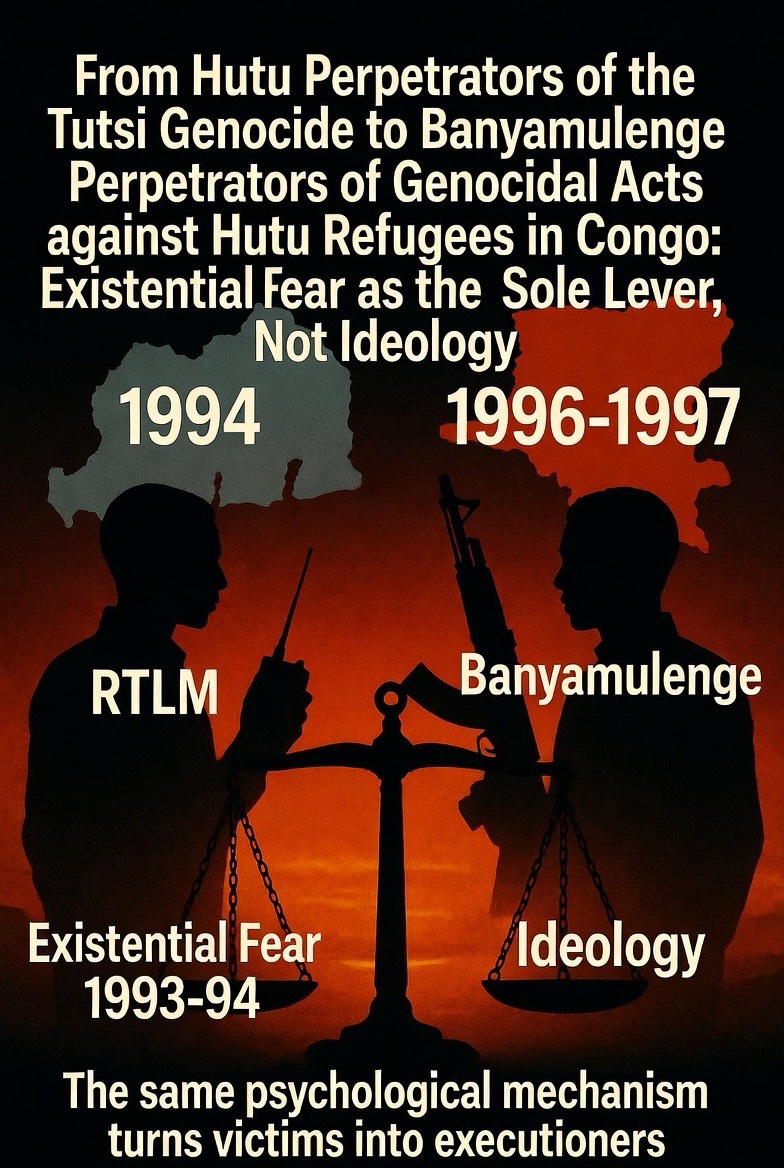
Yet, analysis of the recruitment and mobilization mechanisms of rank-and-file perpetrators reveals a common and predominant psychological driver: the exacerbation and instrumentalization of an existential fear rooted in real traumas.
It was not the implantation of ideology into the cognitive apparatus that determined the shift of ordinary individuals toward the commission of evil.
This short article compares the case of Hutu refugees living in camps around Kigali after February 1993 with that of Banyamulenge elements recruited by the Rwandan Patriotic Army (APR/RPA) to participate in the First Congo War and its associated massacres. The aim is to highlight this universal process while underscoring the contextual, moral, and legal differences.
1. The Recruitment of the Interahamwe and the Role of Internally Displaced Persons (1993–1994)
The Rwandan Patriotic Front (RPF) offensive launched on 8 February 1993 triggered a massive displacement of Hutu populations, estimated at between 800,000 and 1 million people, mainly from the Byumba and Ruhengeri areas.
These displaced persons crowded into makeshift camps around Kigali (notably Nyacyonga) and in the center of the country under conditions of extreme precarity. These camps became a vital recruiting ground for the Interahamwe (the MRND youth militia) and the Impuzamugambi (the CDR militia).
Young men, often traumatized by the violence they had suffered during the RPF advance (summary executions, mutilations, rapes, and the “akandoya” method), were particularly receptive to propaganda from Radio RTLM and the authorities.
The repeated message — “the Inkotanyi (RPF) are already killing our families; they will exterminate us” — transformed a lived fear into a narrative of “preventive defense” of the “it’s them or us” type.
Historians and contemporary reports (Human Rights Watch, MSF) confirm that the rank-and-file perpetrators at roadblocks and in neighborhood killings were drawn overwhelmingly from these displaced populations, alongside unemployed youth and Hutu Burundian refugees who had arrived in Rwanda after the October 1993 massacres.
It was the extremists within the regime who organized and armed these militias, but the bulk of the active manpower came from this pool of fragile individuals.
2. The Conditioning of the Banyamulenge (1996–1997)
Symmetrically, the Banyamulenge (Congolese Tutsi from South Kivu) had faced growing discrimination since the 1980s–1990s, including the withdrawal of citizenship and attacks by local militias (Mai-Mai, Bangilima). In 1996, an expulsion ultimatum issued by Zairian authorities (“leave the country or we will kill you”) intensified the existential threat.
Many young Banyamulenge fled to Rwanda, where they were recruited, trained, and armed by the Rwandan Patriotic Army (APR/RPA). Others formed local militias.
The mobilization discourse was based on real facts: the Hutu refugee camps (more than one million people in 1994–1996) sheltered ex-FAR and Interahamwe elements who continued to launch incursions against local Tutsi and threatened to “finish the genocide.”
The narrative “if we do not destroy these camps, they will start again against us” was the exact mirror of the Hutu discourse of 1993–1994.
Existential fear, rooted in the memory of the 1994 genocide and the persecutions suffered, was instrumentalized through sophisticated psychological conditioning and morally legitimized participation in attacks on the camps and the hunting down of refugees in the forest.
Christopher P. Davey’s 2025 book constitutes the most relevant and recent reference on the subject. It draws directly on interviews with Banyamulenge soldiers and analyzes their transition to violence through the prism of existential fear, the memory of the 1994 genocide, and local threats experienced.
The Banyamulenge Soldier explicitly addresses the participation of Banyamulenge in the massacres of Hutu refugees without essentializing them as “ideologues,” but by placing them within a dynamic of perceived victimization and survival.
3. The Common Psychological Mechanism: Instrumentalized Existential Fear
In both cases, the shift to violence rested on four classic psycho-social elements:
- Activation of group boundaries: reinforcement of the “us” (Hutu victims or threatened Tutsi/Banyamulenge) against a homogenized “them.”
- Homogenization of the enemy: all Tutsi became accomplices of the RPF (1994); all Hutu, including women, children, and the elderly in the camps, became potential génocidaires (1996–1997).
- Collective victimization and existential fear: real traumas (FPR violence in 1993 for displaced Hutu; attacks on Banyamulenge and the memory of the genocide for Tutsi) made the leaders’ narrative credible. It is important to add the factor of ethnic solidarity between Banyamulenge who did not experience the genocide and Tutsi from the interior who were its victims — distinct from Tutsi refugees who came from Uganda.
- Legitimization of preventive violence: killing became a duty of survival (“it’s them or us”).
This universal lever transformed ordinary individuals, often young and traumatized, into perpetrators. Thus, propaganda (RTLM in 1994; military discourse in 1996) did not invent the threat: it amplified and instrumentalized it on the basis of lived experiences.
According to Scott Straus (2006), Radio RTLM actually had a limited impact — less than 15% of mobilizations — while only 3% of perpetrators knew the “Hutu Ten Commandments.”
4. Nuances and Contextual Differences
Despite the identical psychological mechanism, the Tutsi genocide targeted an unarmed civilian minority with no significant mixing with armed elements, accompanied by massive public incitement.
In 1996–1997, the massacres took place within a regional war aimed at dismantling militarized camps that served as rear bases for génocidaires, in a broader campaign to overthrow Mobutu. Nevertheless, systematic and indiscriminate massacres of Hutu refugees (including civilians) did occur.
The UN Mapping Report described these crimes as crimes against humanity and, in some cases, acts of genocide. These crimes were not prosecuted for reasons of realpolitik: the United States did not wish to weaken the new regime expected to stabilize the Great Lakes region, while Rwanda threatened to withdraw from peacekeeping operations if an international tribunal were established.
Estimates indicate more than 200,000 civilian deaths, particularly during the “hunt” for Hutu civilians in the forests.
The Banyamulenge, who did not form the bulk of the organizing forces, were instrumentalized to participate in the massacres while themselves being victims of prior persecutions.
Even if recognizing the similarity of the psychological lever does not imply moral or legal equivalence between the events, identifying these mechanisms offers a lesson on human vulnerability: under the effect of existential fear amplified by propaganda, ordinary individuals can slide into horror, regardless of the side.
Conclusion
Ideology was absent in the minds of the vast majority of perpetrators and is therefore powerless to explain the actions of rank-and-file executors.
In both situations, the real lever was the exacerbation of an existential fear rooted in real traumas, instrumentalized to turn victims into executioners.
This recurring pattern in the Great Lakes region illustrates a universal psycho-social process:
fear → polarization → homogenization → violence justified as group survival.
Understanding this mechanism does not aim to relativize the crimes, but to better grasp how to prevent such cycles of violence. It invites reflection on individual and collective responsibility in the face of the manipulation of fear, without ever excusing criminal choices.
References
Davey, Christopher P. 2025. The Banyamulenge Soldier: Genocide between Congo and Rwanda. Ann Arbor: University of Michigan Press.
Des Forges, Alison. 1999. Leave None to Tell the Story: Genocide in Rwanda. New York: Human Rights Watch.
Human Rights Watch. 1999. The Rwandan Genocide. Various reports.
Office of the United Nations High Commissioner for Human Rights (OHCHR). 2010. Report of the Mapping Exercise documenting the most serious violations of human rights and international humanitarian law committed within the territory of the Democratic Republic of the Congo between March 1993 and June 2003 (UN Mapping Report).
Prunier, Gérard. 1995/1997. The Rwanda Crisis: History of a Genocide. London: Hurst.
Médecins Sans Frontières (MSF). Internal reports and publications on displaced persons camps in Rwanda (1993–1994) and the massacres of Hutu refugees in the DRC (1996–1997).
Amnesty International. Reports on violations in Zaire/DRC (1996–1997).
Straus, Scott. 2006. The Order of Genocide: Race, Power, and War in Rwanda. Ithaca: Cornell University Press.
On the conditioning techniques used on Banyamulenge recruits: https://epoche.fr/2026/04/21/the-psychological-engineering-of-warriors-how-the-rpf-turned-banyamulenge-recruits-into-instruments-of-war/

