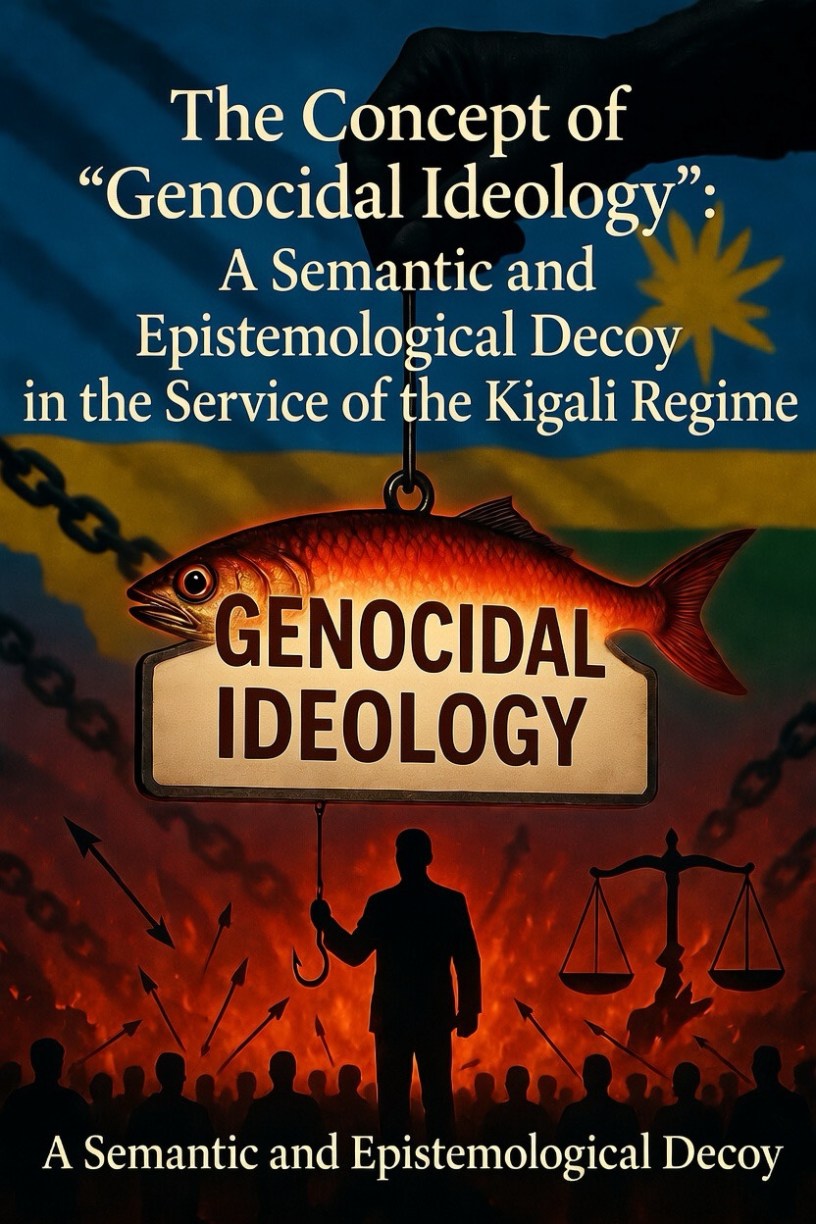
Abstract
The concept of “genocidal ideology” occupies a central place in the official narrative of the Rwandan regime led by Paul Kagame.
It is used to legitimise both domestic repression and military interventions in the Democratic Republic of the Congo (DRC), and is routinely presented as the main cause of the 1994 genocide against the Tutsi.
This article demonstrates that the notion of “genocidal ideology” is a semantic and epistemological decoy. From a logical standpoint, its use leads to a tautology devoid of explanatory value.
Ontologically, it rests on a Platonic bias that attributes an autonomous existence to concepts, independent of social and historical contexts, as well as on a homeomorphic error that confuses the nature of the effect (the genocide) with that of the cause.
Finally, the adjective “genocidal” performs a rhetorical slide from denotation to connotation, creating a locution with strong affective charge but conceptually empty.
Drawing on the empirical work of Scott Straus and Lee Ann Fujii, the article shows that the 1994 genocide resulted primarily from the acute exploitation of collective fear, intra-Hutu social pressure, and opportunity in a context of civil war and chaos — and not from the massive internalisation of a pre-existing racist ideology.
Instrumentalised by the Kigali regime, this concept serves above all to lock down debate, disqualify opposition, and obscure the responsibilities of the Rwandan Patriotic Front (RPF) in the dynamics that made the genocide possible.
A rigorous understanding of mass violence requires abandoning this fallacious framework in favour of an analysis of the concrete mechanisms of violence.
Keywords: genocidal ideology, Rwandan genocide, epistemology, political rhetoric, Kagame, FDLR, mechanisms of mass violence.
Introduction
Since the Rwandan Patriotic Front (RPF) took power in 1994, the perceived legitimacy of President Paul Kagame has rested largely on strict control of the narrative surrounding the causes and genesis of the 1994 genocide.
An official semantic corpus has gradually imposed itself as a quasi-sacred vulgate, comparable to the sunna composed of the hadiths — the collected acts and sayings of the preacher Mohammed in the Islamic tradition.
Any questioning or deviation from this narrative exposes its author to the regime’s full legal and repressive arsenal: laws on “revisionism,” “negationism,” and above all the accusation of propagating a “genocidal ideology.”
It is this last accusation that particularly interests us here. Today it is used by the Kigali regime to justify its military involvement and repeated territorial aggressions in the Democratic Republic of the Congo (DRC), under the pretext of the presence of the Democratic Forces for the Liberation of Rwanda (FDLR) alongside other armed groups.
In order to single out the FDLR threat — which is far from constituting an existential military danger to Rwanda — the regime’s communicators have recycled and expanded the concept of “genocidal ideology” supposedly implanted in the minds of the enemy.
The present article demonstrates that this concept is irrelevant for explaining the causes of the 1994 genocide, during which at least 500,000 Tutsi from inside Rwanda were eliminated in horrific conditions.
Before presenting the structural, political and social factors that led to the genocide and explaining the interactions and concrete mechanisms that emerged from them, we will first show that the discourses and theoretical systems that mobilise the concept of “genocidal ideology” lack logical value and, consequently, scientific value.
We will thus demonstrate that conceiving “genocidal ideology” as an autonomous entity, existing independently of individuals and social contexts — in the manner of a Platonic essence — in no way explains the concrete sequences that led to the horror of 1994.
This concept fails to account for either the genocide of the Tutsi inside the country or the massacres of Hutu perceived as RPF sympathisers, often misleadingly labelled “moderate Hutu” — an expression that implicitly suggests that the vast majority of Hutu were “extremists,” even though active participation in the killings is estimated at less than 5% of the Hutu population.
I – Logical and Ontological Analysis of the Concept of “Genocidal Ideology”
The concept of “genocidal ideology,” widely used by the Kigali regime, deserves rigorous examination from both a logical and an ontological perspective.
This analysis aims to show that its use creates profound philosophical and cognitive difficulties. On the one hand, it leads to a tautology empty of explanatory content, since a tautology has, by definition, no ontological value (cf. Mario Bunge).
On the other hand, it rests on problematic presuppositions: a Platonic conception of concepts, a homeomorphic error that assimilates the nature of the effect to that of the cause, and a rhetorical slide between denotation and connotation.
These three dimensions will be examined in turn, before demonstrating that this conceptual framework is incapable of illuminating the concrete mechanisms of the 1994 genocide or addressing its empirical causes.
A. The use of the concept “genocidal ideology” leads to a tautology
The statement “the Hutu genocidal ideology led to the genocide,” by using the definite article, is in our view an analytic proposition and not a synthetic judgement, in the Kantian sense.
Those who employ the concept implicitly define it as an ideology that necessarily leads to genocide. By the principle of substitution, the statement “it is the infusion of a genocidal ideology that led to the genocide” becomes “it is the infusion of an ideology that leads to genocide that led to the genocide.”
This is therefore to utter a tautology devoid of explanatory or ontological value. It is like saying “Mr X’s desire to kill his wife led Mr X to commit voluntary homicide on his wife,” or “the desire to kill led to killing.”
Clearly, such formulations explain nothing about real mechanisms, since tautologies never inform us about reality. They have no ontological import.
When the Rwandan regime claims to “combat the FDLR because they carry a genocidal ideology,” it ultimately says nothing of substance. The danger is explained by the danger itself.
This rhetoric dispenses with analysing the real mechanisms: structures of power, economic and political crises, dynamics of fear, interests that instrumentalise these narratives, the role of media and militias, the geopolitical context (tensions with the DRC, presence of armed groups in Kivu, regional interests) and concrete power calculations.
A serious prevention strategy cannot content itself with turning the locution “genocidal ideology” into a magic incantation. It must tackle the real mechanisms.
B. The Platonic bias
The use made by Kigali of the concept of “genocidal ideology” appears to rest on the idea that concepts possess an autonomous existence, an ontological reality independent of linguistic practices and the historical contexts that produce them — as if circumstances, the context of civil war and the surrounding chaos had played only a very minor role in the occurrence of this tragedy.
This Platonic thesis has been widely refuted: by Aristotle himself, who subordinated it to matter, by medieval scholasticism, then by analytic philosophy (Wittgenstein, Quine), pragmatism and linguistic anthropology.
Concepts are not real things: they have no eternal essence. As Mario Bunge reminded us: “Constructs do not change. Only real things change.”
To consider, or pretend to consider, “genocidal ideology” as an autonomous entity, independent of individuals and social situations, is to adopt a Platonic ontology that makes the concrete processes that led to the horror incomprehensible.
This usage is reinforced by a classic cognitive bias: the similarity bias or homeomorphic error (from the Greek: same form), according to which the nature of effects would necessarily be identical to that of the cause.
C. The similarity bias or homeomorphic error
Arbitrarily assimilating the nature of the result (the genocide) to that of the “cause” (genocidal ideology), as if the nature of effects determined that of the cause, results from a cognitive bias. The commission of genocidal acts does not necessarily require that a genocidal ideology be encoded in the brain of their perpetrator.
Most often, reality is heteromorphic: cause and effect frequently have very different, even radically opposed, forms and natures. Spinoza already reminded us that “effects do not necessarily resemble their causes.”
The cause does not need to “contain” the effect in miniature; it is often of a very different, modest or indirect nature.
A small spark can cause a vast forest fire; a single genetic mutation can, over millions of years, lead to a new species; the flapping of a butterfly’s wings (the butterfly effect in chaos theory) can, in theory, trigger a hurricane.
In history, major transformations (the fall of an empire, a revolution) often have modest or indirect initial causes.
Applied to genocide, this means that acts qualified as genocidal do not systematically require a genocidal intention or the integration into the perpetrators’ mental structures of a particular ideology.
This is what the principal expert witness before the ICTR, Alison Des Forges, expressed in her own way when questioned by the Appeals Chamber of the ICTR:
“While seeing the existence of a plan clearly, I have no way, no manner of establishing that the persons who participated in this plan had the intention to commit a genocide and to…”
“And, in fact, I suppose even that some did not have this intention.
Question: So, Madam, you think that persons were able to participate in this planning of the genocide in a non-intentional manner; have I understood correctly? […]
And so, I would not draw that type of conclusion; I would rather say that it was persons — or that it is possible that it was persons — who participated in the planning of a civil self-defence programme before 6 April, and whose intention was not necessarily to commit a genocide.
Because I have no means of knowing or proving that there was a genocidal intention on the part of each of these persons.”
Beyond the similarity bias between effects and their causes, there is also a confusion between denotation and connotation.
D. The confusion between denotation and connotation
In the expression “genocidal act,” the adjective “genocidal” legitimately refers to the signified — that is, the concept denoted by the signifier, the idea of a crime aimed at the total or partial destruction of a group.
By contrast, when this adjective is juxtaposed with the noun “ideology,” a significant rhetorical slide occurs.
The use of the adjective no longer aims to denote but to connote. We move from a function of denotation to a desire for connotation.
The adjective “genocidal” no longer serves to qualify or specify a precise ideology with identifiable content, but to project onto the term “ideology” the overwhelming emotional and moral charge associated with the word “genocidal.”
We thus create a locution with strong affective and semiotic power, but conceptually empty.
II. The Concrete Mechanisms of the 1994 Genocide: Fear, Social Pressure, Opportunity and the Absence of Massive Internalisation of a “Genocidal” Ideology
Contrary to what the post-genocide Rwandan sunna seeks to signify — that the 1994 genocide was the inevitable result of a genocidal ideology deeply rooted in Hutu minds — historical facts contradict this thesis.
The genocide resulted neither from a millennial racial hatred nor from propaganda that had “formatted” brains since the 1960s. It is explained above all by the acute exploitation of a state of collective fear and the “us or them” cleavage, in a context of civil war, presidential assassination and total chaos.
We will examine successively the concrete factors that led hundreds of thousands of ordinary Rwandans to participate in the massacres: the existence of a substratum of real fears, the rapid rise of collective fear, the role of intra-Hutu social pressure, opportunity, and the absence of massive internalisation of a “genocidal” ideology. The empirical studies of Scott Straus and Lee Ann Fujii will support this analysis.
A. The existence of a substratum of real and epistemologically justified fears
It should be noted that a substratum of real fears existed. First, fear of the RPF (Rwandan Patriotic Front, predominantly Tutsi), fear of a return to Tutsi domination, fear of massacres like those that occurred in Burundi following the assassination of the Hutu reconciliation president Melchior Ndadaye in October 1993 by Tutsi elements.
The memory of the genocide of the Hutu elite in Burundi, which claimed at least 150,000 lives, was also a factor that made fear legitimate — the first genocide in the Great Lakes region having been committed by Tutsi elements.
Another factor of fear was the RPF attack in February 1993, accompanied by massacres, which provoked the exodus of approximately one million refugees, some of them terrorised by what they had seen.
Testimonies of massacres perpetrated by the RPF in Ruhengeri and Byumba spread in the camps, allowing extremist Hutu elites, acting skilfully and cynically, to transform these fears into a survival imperative: “Kill them before they kill you.”
The rise of this collective and exacerbated fear was a recent phenomenon, since before 1990 Hutu and Tutsi often lived in good harmony (neighbours, mixed marriages, same churches and schools).
Ethnic tensions were neither constant nor rooted enough to provoke a spontaneous genocide.
B. The lessons of empirical studies and the absence of massive internalisation of a racist and/or hateful genocidal ideology
Empirical studies have shown that the ideological corpus constituted by the Hamitic theory and the “Hutu Ten Commandments” had produced effects only on a minority of elites.
This corpus was not widely internalised and was not the main driver for the hundreds of thousands of ordinary participants (peasants, fathers of families).
In his book The Order of Genocide (2006), Scott Straus, drawing on empirical studies — that is, semi-structured interviews with more than 200 convicted génocidaires — explicitly refutes the idea of a deeply and anciently rooted ideology as the main cause of the genocide.
He concludes that the mechanisms that pushed individuals to kill were not primarily linked to ethnic prejudices, pre-existing antipathy, manipulation by racist propaganda, or nationalist commitment.
Overall, Hutu did not kill Tutsi because they hated them, considered them non-human, or were steeped in a Hutu nationalist ideology.
The main factors were uncertainty and fear linked to the war, intra-Hutu social pressure, and opportunity.
The term “Inyenzi” (cockroach), often cited as proof of dehumanisation, was originally a positively connoted acronym, the result of a self-designation by exiled Tutsi fighters (“Ingangurarugo yemeye kuba ingenzi”: member committed to bravery). It became pejorative later, from the 1960s attacks launched from Uganda by Tutsi monarchists, but did not reflect a generalised systematic dehumanisation.
Lee Ann Fujii, in Killing Neighbors (2009), contrasts the thesis of “ethnic hatred” with that of “ethnic fear” exploited by the elites.
Participation in the massacres resulted from intra-Hutu pressure (death threats in case of refusal), social ties (groups of neighbours forced to “do as everyone else”), and immediate fear of the RPF — and not from an internalised racist ideology.
“It was not overwhelming hatred for Tutsi that Joiners felt but an overwhelming sense of fear.”
RTLM radio had a limited impact — less than 15% of direct mobilisations according to Straus — and only 3% of killers knew the “Hutu Ten Commandments.”
The killers were ordinary men acting under coercion, fear and opportunity in an intense climate of defensive war.
This is why projecting Gregory Stanton’s conceptual grid (stages of genocide, including dehumanisation) onto the processes (succession of changes of state of things over time) and the singular events that led to the genocide is a manifest epistemological error, since this grid is ultimately devoid of explanatory and predictive power.
This methodological bias resembles the phenomenon of precession of models developed by Baudrillard, or the mechanism described by Jean Piaget whereby human beings tend to assimilate real objects, including facts, to pre-existing conceptual grids and already incorporated schemes of thought.
The accommodation that consists in adjusting conceptual schemes to improve their power of representation of reality requires an effort that it is sometimes tempting to forgo — especially when the dominant conceptual grid serves a political agenda.
III. The Concept of “Genocidal Ideology”: A Rhetorical Decoy in the Service of Power and an Instrument of Diversion
Even today, the regime of Paul Kagame mobilises the same concept to justify its repeated military operations in the Democratic Republic of the Congo (DRC). By invoking the need to “combat the genocidal ideology” of the Democratic Forces for the Liberation of Rwanda (FDLR), the Rwandan government transforms a complex political, security and historical problem into a simplifying rhetorical formula.
Having become a veritable catch-all term, the concept of “genocidal ideology” fulfils, to the benefit of the Kigali regime, several strategic functions:
- legitimise military interventions across the border on Congolese territory;
- disqualify any form of opposition, whether internal or external, by assimilating it to an existential threat;
- perpetuate a permanent victim narrative that justifies both domestic authoritarianism and the political marginalisation of the Hutu.
By reducing multifactorial dynamics to a single malevolent essence, this concept conveniently dispenses with analysing structural causes, responsibilities — including those of the RPF — and the geopolitical calculations at play.
It thus reproduces the same tautological circle already observed: the nature of the effects is attributed to the cause by creating the term “genocidal ideology” to make it the essential cause.
The concept of “genocidal ideology,” empty of explanatory content, serves above all to lock down public debate, stifle all contestation and consolidate the regime’s control over the historical and political narrative. It sheds light neither on the concrete mechanisms of the 1994 genocide nor on the real nature of the current conflicts in eastern DRC.
More fundamentally, the permanent invocation of “genocidal ideology” makes it possible to obscure the responsibility of the Rwandan Patriotic Front (RPF) in creating the conditions that made the genocide inevitable in the event of an extremely powerful trigger such as the assassination of President Juvénal Habyarimana on 6 April 1994 and that of Colonel Élie Sagatwa, considered an officer close to the circle of Hutu extremists and one of the most radical figures of the regime.
Before concluding, it is worth recalling that four days before the attack that triggered genocidal fury, Paul Kagame told General Dallaire that the country was “on the eve of a cataclysm and that once triggered, no means would allow it to be controlled.”
Conclusion
The concept of “genocidal ideology” proves, in the final analysis, to be a semantic and epistemological decoy devoid of any real explanatory power. It neither allows us to understand the concrete mechanisms that led to the horror of 1994 — collective fear, social pressure and opportunity — nor to illuminate the current dynamics in eastern DRC.
Instrumentalised by the Kigali regime, this concept functions above all as a tool of rhetorical legitimisation: it justifies cross-border military interventions, disqualifies all opposition and perpetuates a victim narrative that locks down public debate.
By reducing complex historical processes to a single malevolent essence, it conveniently dispenses with analysing real responsibilities, power calculations and the structural conditions that made the genocide possible.
Rather than endlessly repeating a magic formula devoid of scientific content, a serious approach to Rwanda’s past and the regional conflicts requires abandoning this fallacious concept in favour of the rigorous study of the concrete mechanisms, political contexts and social dynamics that shape mass violence.
Only this demand for lucidity will make it possible to escape the tautological cycle and build an authentic understanding of past tragedies as well as present stakes.
Main References
- Bunge, Mario (several works on ontology, notably on the distinction between constructs and real things).
- Dallaire, Roméo A., & Beardsley, Brent (2004). J’ai serré la main du diable: La faillite de l’humanité au Rwanda. Montréal: Libre Expression.
- Fujii, Lee Ann (2009). Killing Neighbors: Webs of Violence in Rwanda. Ithaca: Cornell University Press.
- Straus, Scott (2006). The Order of Genocide: Race, Power, and War in Rwanda. Ithaca: Cornell University Press.
¹ Lemarchand, R. (2002). Le génocide de 1972 au Burundi. Les silences de l’Histoire. Cahiers d’études africaines, 167(3), 551-568. https://doi.org/10.4000/etudesafricaines.156.

