Despite the official narrative of “ethnic amnesia” and the “Ndi Umunyarwanda” (“I am Rwandan”) campaign launched in 1994, which claims to have erased all ethnic distinctions, empirical evidence reveals a structural ethnic monopoly within Rwanda’s security and intelligence institutions.
In a detailed 2021 study titled “From ethnic amnesia to ethnocracy: 80% of Rwanda’s top officials are Tutsi,” Belgian academic Filip Reyntjens examined the backgrounds of 209 of the country’s highest-ranking officials.
Of the 205 profiles in which paternal ethnic origin could be reliably determined, 166 were Tutsi — representing 81 percent. The dominance is even more pronounced in the most sensitive sectors: 86 percent of top positions in the Rwanda Defence Force (RDF) and security services, 86 percent of ambassadors, and 96 percent of the directors of major public agencies.
These figures primarily concern Tutsi who belonged to the former Rwandan Patriotic Front (RPF) or who returned from the diaspora in Uganda, Burundi, and Tanzania.
This selective recruitment operates through informal mechanisms of genealogical verification and “proof of survival” that bypass the legal prohibition on mentioning ethnicity in official identity documents.
Membership in IBUKA — the national association of genocide survivors, which is almost exclusively composed of Tutsi who lived inside Rwanda — or in the AERG (Association of Genocide Survivor Students and Pupils) serves as a strong indicator of Tutsi origin.
However, the decisive criterion for sensitive posts often remains access to the Genocide Survivors Assistance Fund (FARG), created in 1998 and formalized by Law No. 02/2009.
This fund is explicitly reserved for survivors of the “genocide against the Tutsi.”
Orphans or widows whose Hutu parent was killed for refusing to side against the RPF (“moderate Hutu”), for belonging to the Hutu opposition, or for protecting Tutsi, are systematically excluded.
In practice, IBUKA functions as an unofficial ethnic civil registry.
As early as 2003, Human Rights Watch observed that the FARG “mainly supported Tutsi” and that surviving Hutu viewed this exclusion as discriminatory.
A concrete example highlights this disparity: a Tutsi orphan whose parents were killed in 1994 receives full scholarships, priority housing, and psychological support through FARG.
By contrast, an orphan whose Hutu father was murdered by the Interahamwe — for hiding Tutsi or refusing to participate in the genocide — is denied access to these same benefits.
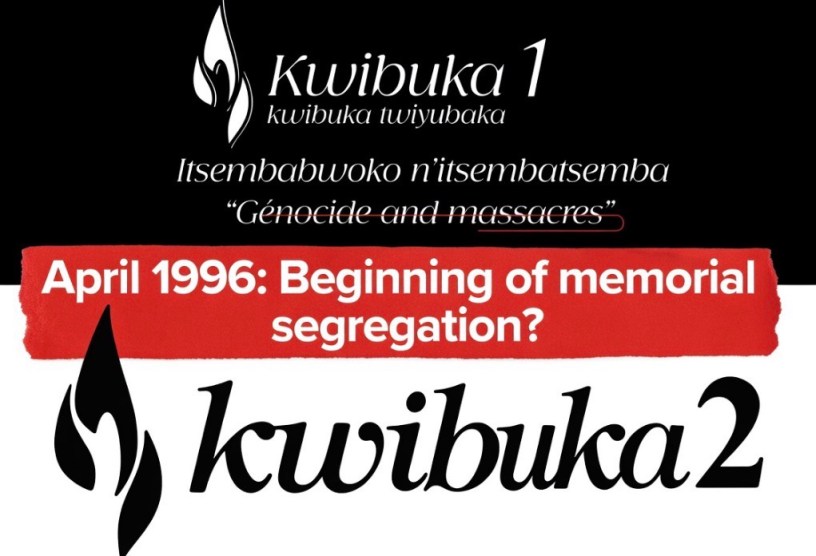
It is worth recalling that during the first official commemorations in 1995, the phrase “Itsembabwoko n’itsembatsemba” (“genocide and massacres”) explicitly referred both to the genocide against the Tutsi and to the massacres of Hutu accused of complicity with the RPF. At that time, the suffering of both groups was considered inseparable.
Yet from 1996 onward, the logic of reconciliation broke down.
Hutu victims were swiftly erased from official memory. Memorial segregation had begun, accompanied by the progressive instrumentalization of national commemorations.
The treatment of “Hutu rescuers” further illustrates this imbalance. Rwanda has created the official category of Abarinzi b’Igihango (“Protectors of the Covenant”). However, unlike Israel’s Yad Vashem, which operates an independent, transparent, and systematic commission that has recognized more than 28,700 “Righteous Among the Nations,” Rwanda’s recognitions remain sporadic, symbolic, and tightly controlled by the government.
In 2016, only 17 individuals were honored in a national ceremony. In 2018, President Kagame personally praised just four people. In 2019, three more were recognized, including one American citizen.
The deliberately limited number reinforces the official narrative that “very few Hutu saved Tutsi,” despite independent research — notably Paul Conway’s 2011 study — and NGO testimonies suggesting thousands of rescue acts occurred.
The absence of an independent commission and a formal honor system comparable to Yad Vashem prevents any large-scale, public acknowledgment of Hutu rescuers.
In conclusion, the official discourse of ethnic erasure masks a discreet but highly effective system of selection based on affiliation with Tutsi survivor networks and exclusion from aid reserved exclusively for the “genocide against the Tutsi.”
These mechanisms, documented by Filip Reyntjens (2021), Human Rights Watch (2003), and various international comparative analyses, demonstrate that the much-vaunted national reconciliation remains largely superficial.
In his book Shake Hands with the Devil (French edition, p. 588), Major-General Roméo Dallaire, former commander of UNAMIR, reflected:
“Who exactly was pulling the strings during this campaign? I found myself plunged into dark thoughts, wondering whether the campaign and the genocide had not been orchestrated for a return to the pre-1959 status quo in Rwanda, when the Tutsi ran everything.”
It appears he may have been right on at least one count.
The invasion of October 1, 1990, ultimately resulted — and quite likely aimed — in establishing a de facto ethnocracy that continues to this day.
As long as these informal ethnic filters remain in place, the gap between the “Ndi Umunyarwanda” rhetoric and the reality of power will continue to fuel legitimate skepticism regarding the true depth of Rwanda’s national reconciliation process.
References
- Reyntjens, F. (2021). “From ethnic amnesia to ethnocracy: 80% of Rwanda’s top officials are Tutsi.” African Arguments, 24 November.
- Human Rights Watch (2003). Justice Compromised: The Legacy of Rwanda’s Community-Based Gacaca Courts (section on FARG).
- Conway, P. (2011). “Righteous Hutus: Can stories of courageous rescuers help in Rwanda’s reconciliation process?” International Journal of Sociology and Anthropology, 3(7), 217–223.
- Official website of President Kagame and The New Times (2016–2018) reports on Abarinzi b’Igihango ceremonies.
- Yad Vashem (updated 2024 figures) for comparative data.
 Journal d'idées