The word “Islamophobia” is deliberately ambivalent; it is designed to create intentional confusion between believers and their beliefs, effectively banning in practice the criticism of beliefs, superstitions, or religious norms with societal ambitions.
On March 15, 2022, the representative of the French State spoke accurately before the United Nations General Assembly plenary on the concept of islamophobia.
The UN report (consultable in full on the UN website) summarizes the French position as follows:
Click here to access the press release
“The representative of France reaffirmed the unequivocal fight against all forms of discrimination.
He noted that the term ‘islamophobia’ has no agreed-upon definition in international law, unlike freedom of religion or belief.
Yet it is this freedom that France defends, just as it defends all public freedoms, for example freedom of expression or freedom of belief.
This formulation also suggests that it is the religion itself that is protected as such, and not the believers; however, what must be promoted is the freedom to believe, not to believe, or the right to change religion, he explained.
Furthermore, he explained, by creating an International Day to Combat Islamophobia, the resolution does not address the concern—which we all share—of fighting all forms of discrimination, because it segments the fight against religious intolerance by singling out one religion to the exclusion of others, without reference to the freedom to believe or not to believe.”
Should we therefore expect the creation of days dedicated to each religion, to each degree of belief or non-belief? he asked, pointing out that “the calendar would not suffice,” especially since a few months earlier we had adopted a resolution in memory of the victims of discrimination based on religion or belief.”
In my view, the French position is perfectly just and balanced.
It is normal to be able to criticize religious beliefs—and thus Christianity, Judaism or Islam—especially when a certain version of Islam seeks to impose its norms and superstitions on society.
In reality, there is not ONE Islam but several competing representations of Islam.
Some of these representations, such as that of Mahmoud Mohammed Taha, are enlightened, tolerant, and freed from the superstitions and fantasies that weigh down humanity.
Others are genuinely open to criticism, or even detestable in certain respects.
I am referring to that normative, supremacist Islam nourished by Hudûd (cruel punishments), literalism, hadiths, outdated customs, superstitions, and attachment to respect for sharia.
Elements of this version of Islam fill a certain repertoire of childish superstitions, sometimes homophobic, violent, anti-Jewish, anti-unbeliever, sexist scripts…, a repertoire from which some minds unfortunately draw all too easily.
Another fundamental point is fitna, i.e. division among believers.
This is deliberately presented by adherents of this normative Islam as a true sacrilege, the worst of sins or catastrophes, in order to dissuade Muslims from criticizing this intolerant sharia, these outdated hadiths, and certain childish superstitions.
By preparing the ground for the guilt-tripping of moderates and Sufis, the supremacist supporters of this normative hadith-based Islam—driven by frériste-type action systems—avoid having this version of Islam they seek to advance disqualified.
How can a Muslim permeable to this normative vision of Islam—which constantly publicly displays its norms, convinced that sharia is perfect—condemn actions that fit into this Manichean worldview conveyed by sharia and its corpus of supposedly authentic hadiths, which rule on everything from the fate of the adulterous woman to the “fart” produced during prayer?
How can Muslims, convinced by the dogmas of Muhammad’s infallibility and impeccability that are constantly hammered into them, not feel guilty when they are legitimately tempted not to take seriously the hadiths (words and acts that Islamic tradition attributes to Muhammad) whose authenticity is affirmed by the “religious scholars”?
Among these hadiths, most often wrongly labeled as authentic, unfortunately we find all sorts of superstitions that can be implanted in brains conditioned from a very young age to welcome them.
For example, how can one take seriously the tradition reported by Abu Hurayra (reported by Al-Bukhari in his Sahih no. 6223) claiming to report the following words from Muhammad:
“Indeed Allah loves sneezing and hates yawning. Thus if one of you sneezes and praises Allah, it is incumbent upon every Muslim who hears him to say: Yarhamouka Allah.
As for yawning, it comes from Shaytan. Let the person suppress it as much as possible, and if he says ‘Ahh’ then Shaytan laughs at him.”
It suffices to consult the sites that feed normative Muslims and hadith adherents to observe the ridiculousness of the questions posed as well as that of the hadiths claiming to provide the answers.
Just for a smile, we can cite the question of the “ritual purity status of one who farts often” or that of the “ruling on one who doubts having farted during prayer”:
The ruling on one who doubts having farted during prayer – Islam Question & Answer
The ritual purity status of one who farts often – Islam Question & Answer
Naturally, a non-Muslim is likely to burst out laughing when consulting, for example, the site islamqa.info, whose answers rely on supposedly authentic hadiths, i.e. words supposedly actually spoken by Muhammad (Mohammed).
The normative Muslim, on the other hand, is capable of feeling guilty over insignificant details.
Another example, according to Abu Hurayra (reported by Ahmad and authenticated by Sheikh Albani in Sahih Targhib no. 3700, Hadith Hasan li Ghayrihi), Muhammad reportedly said:
“The people of Paradise are beardless, without beard, white, with curly/fris curly hair and eyes lined with kohl.
They are 33 years old and in the image of Adam, they are 60 cubits tall.”
Another hadith considered authentic: “According to ‘Uthman ibn Abi l ‘Ass رضي الله عنه who came to the Prophet صلى الله عليه وسلم and said:
‘O Messenger of Allah, the devil interferes between me, my prayer and my recitation and distracts me.’ The Messenger of Allah صلى الله عليه said then:
‘This is a devil called khanzab; when you sense his presence, seek refuge with Allah from him and spit dryly three times to your left.’ He said: ‘That is what I did and Allah removed him from me.’” (Reported by Muslim in his Sahih no. 2203)
Could a Christian imagine a Jesus ruling on such trivial subjects?
Even an atheist reading the four Gospels without attaching to the rest of the New Testament would struggle to find even one word attributed to Jesus that is futile, unreflective, laughable or petty.
So one of two things: either Muhammad never uttered the words contained in these hadiths whose chains of transmission (isnad) are supposed to confer a high degree of authenticity, or Muhammad stooped to answering the most trivial questions imaginable with simple expedients.
The problem is that by habituating minds—or conditioning them to swallow such nonsense—one generates generalized credulity and a terrible lowering of critical thinking.
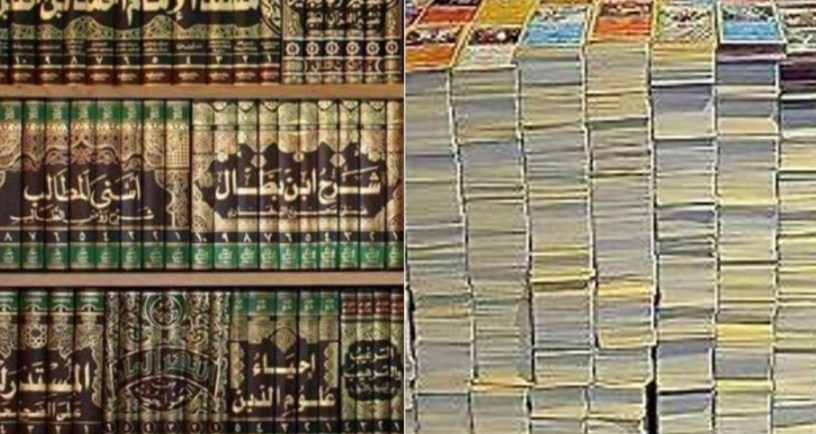
Political, normative, concordist Islam is an Islam of hadiths where people trade hadiths like children trade Pokémon cards.
Each hadith represents an aspect—even intimate—of Muhammad’s life, a narrative Pokémon to transmit. “Do you know this one?” “Ah no I didn’t know it. I have a new one, it’s authentic…”
Ultimately, the mass of hadiths creates material for discussion and fills the void.
They are exchanged like one would exchange Pokémon, which maintains a form of socialization among hadith collectors.
The interest of these short narratives is that they are most often short stories suited to simple modes of cognition.
They appear in several traditions. So they have several versions transmitted by different chains of transmission (isnad).
Religious scholars most often limit themselves to evaluating the degree of authenticity of the hadith through examination of the chain of transmission (isnad).
If the chain of transmission seems solid to them, the even stupid content of a hadith will never be discussed.
Ahmad b. Hanbal, the founder of the legal school bearing his name, always showed great mistrust, even contempt, towards reason.
He expressed himself in these terms: “A narration of weak reliability attributed to the Prophet Muhammad is worth more to me than the use of reason.”
Doesn’t Tilman Nagel write: “even a Muslim will sometimes rack his brains over the lack of plausibility of certain statements in the authoritative texts, but emerging doubts must be stifled by referral to the miracle.”
According to Hocine Kerzazi, “the Hadith is an emblematic marker of a Muslim historiographical surreality.
Historico-critical investigations leave little doubt about the authenticity of these prophetic narratives, even if few Muslims have yet sacrificed this conviction.”
In other words, even hadiths qualified as authentic by tradition are very rarely authentic.
Fazlur Rahman, a contemporary Muslim reformist, author of the book “Islam and Modernity”, considers essentially correct the thesis of the orientalists Schacht and Goldziher, according to which most of the words attributed by hadiths to Muhammad were not pronounced by him and that many hadiths were forged to legitimize purely political or personal positions.
Even the moral integrity of certain companions of Muhammad, often at the origin of the chain of transmission, is sometimes questioned.
The Muslim thinker Mahmud Abu Rayya (1889-1970) considered the idea that the Prophet’s companions were all upright to be absurd.
He demonstrated in support of his thesis that Abu Hurayra, one of the Prophet’s companions and transmitter of hadiths, was a dishonest opportunist.
Yet in the 11th century, the hadith collector Al-Khatîb of Baghdad expressed himself in these terms before Caliph Hârûn al-Rashîd: “If the door of criticism of the companions of the Prophet were opened, Muslims would lose the sharia.”
Ibn al-Jawzi, the jurist, declared: “When we arrive at an opinion through our reasoning, we transform it into a hadith.”
Today, all this work questioning the authenticity of so-called “authentic” hadiths has not permeated the minds of adherents of normative hadith Islam.
They can thus continue to exchange and produce dialogues of the type “I find version X more interesting.” “Yes, yes, the isnad is solid, it’s an authentic hadith, I will now make sure not to yawn too much.”
Thus each one gives himself the feeling of erudition.
The knowledge of each adherent of this normative hadith Islam thus becomes quantitative knowledge, and not the science of great syntheses based in particular on logic and reasoning.
Knowledge is thus relegated to this quantitative phenomenon that is erudition which, when not accompanied by an effort of synthesis and criticism, generates this spirit of erudition that Alexandre Koyré considered to be the antithesis of the scientific spirit.
Likewise, theological reflection—which consists in trying to reconcile revelation with reason—is rarely practiced by adherents of normative hadith Islam.
Hadith-mania ultimately keeps populations in a state of credulity because these populations do not want to imagine that most of their narrative Pokémons are counterfeits, words and acts that were never pronounced or committed by Muhammad.
Between the idealized Muhammad and the historical Muhammad, there is a world.
The Muslim wears a beard because one must absolutely imitate Jean-Sol Partre or rather Muhammad who, in the eyes of hadith adherents, represents what Jean-Sol Partre in “Froth on the Daydream” represented in the eyes of his fans.
Adherents of normative hadith Islam who also want Muhammad’s hairstyle and to do “everything the same” are like those imaginary fans in “Froth on the Daydream” who exclaim, “this shirt is exceptional because it belonged to Jean-Sol Partre”, and ask the hairdresser “the same haircut as Jean-Sol Partre”,
Thus “Muhammad” are the most common names among Muslims just as “Jean-Sol” could be in an imaginary world where Jean-Sol Partre would be the secular prophet of humanity.
 Journal d'idées