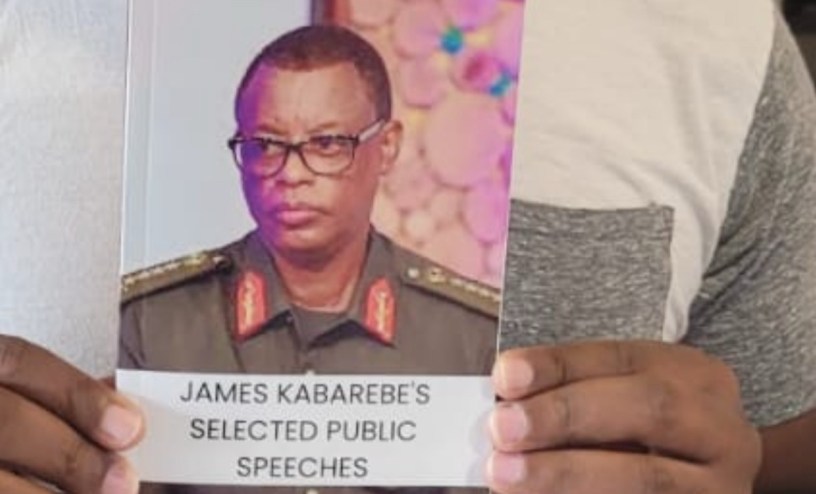
In November 2019, James Kabarebe addressed a gathering of youth from the AERG (Association of Student Survivors of the Genocide) in Kigali.
During his speech, Kabarebe primarily spoke in Kinyarwanda, the native language, with occasional use of English.
This event was recorded and uploaded to YouTube. Below is an English-translated transcript of Kabarebe’s speech.
Greetings, everyone!
[Applause]
I’d like to express my appreciation for the leadership of AERG. Allow me to begin by applauding both the AERG leadership and all of you, the dedicated members, for your outstanding organization and the initiative to convene and engage in discussions concerning progress, whether it pertains to individual growth or the advancement of our nation as a whole.
First and foremost, this is an incredibly constructive idea. »
It’s truly inspiring and worthy of praise. « There’s nothing quite as valuable as a constructive idea. Every positive outcome originates from constructive thinking.
When an individual harbors constructive thoughts, or when a group collectively embraces such ideas, their actions and plans come to fruition, consistently producing favorable results without a shadow of doubt. »
I applaud both you and the AERG leadership for undertaking this admirable initiative and for dedicating your time to participate in this conference.
Your commitment and efforts in organizing and attending such conferences have not gone unnoticed, and they are truly commendable.
Among the various discussions we will have today, I won’t delve extensively into the historical events that shaped the emancipation of our nation, our values, and the hardships our people endured.
We’ve explored these topics extensively in the past. I will primarily focus on the challenges we anticipate in the future—and how we can confront them head-on.
[Clears throat] As mentioned by the previous speaker, we’ve indeed grappled with the aftermath of genocide, which is undeniably true.
However, it’s important to clarify that our confrontation with the aftermath of genocide isn’t bound by time; it persists.
We are currently combating genocidal ideologies, and dealing with the enduring consequences of past genocides—[he pauses, taking a brief moment to carefully consider his words] in fact, we are currently addressing the potential for future genocides.
This is a battle. A struggle. A struggle that necessitates adherence to the fundamental principles that have guided RPA (Rwandan Patriotic Army) and RPF (Rwandan Patriotic Front soldiers).
These principles require us not to overlook even the minutest detail or piece of information.
This is a constant reminder to always « Be on Standby. »
Indeed, a call that you stand poised to personally take action, fully equipped to lend your service whenever duty calls, and such will be your contribution.
You must remain prepared for the moment duty calls. If you are not ready when duty calls, you won’t be accessible, and consequently, you won’t be of any use. You’ll be ineffective and incapable. We need no drunkards and drug addicts.
You can’t expect to be a drunkard or a drug addict and have any meaningful role in shaping our national agenda.
Let’s be clear — our nation doesn’t have time for those who endlessly lament about their trauma.
Here, we don’t entertain trauma as an excuse. Revealing your trauma is the express ticket to return to your place of origin.
Embracing trauma is surrendering to your own demise. It’s a concession that equates to self-defeat and the surrender of your very existence.
I state this because the one who sought to end your life had precisely that intention.
Even in the absence of the assailant, yielding to trauma means they’ve succeeded in their mission to annihilate you.
Trauma is a mind game, a battle within. When you surrender to it, you’re essentially signing your own psychological death warrant.
But when you stand tall, confront it head-on, and refuse to yield, that’s when you emerge victorious, defeating its grip on you.
That’s the brutal truth about trauma. To conquer it, you need an unparalleled, relentless force. It’s a battle that demands no less.
After 1994, you’re well aware of how our adversaries scattered.
Many fled to Congo, some sought refuge in Tanzania, while others dispersed to various corners of Africa.
As for the so-called wealthy elite, they fled to distant overseas havens like Europe and whatnot. « There was this phase — a phase of nothing but chaotic, widespread flight.
Quite a spectacle of mass exodus. A collective state of disarray, for they, too, found themselves in a state of disorientation.
Indeed, the disorientation they faced cannot be equated to the profound suffering endured by the victims of genocide.
The disorientation experienced by these adversaries stemmed from their removal from political power, defeat, and the denial of access to the essentials that once fueled their social and political influence.
They were forced into the status of refugees, having to start anew from scratch, even those who settled overseas in Europe and various other places.
The experiences of refugees who sought asylum in Europe and those who found themselves in the dense forests of Congo share striking similarities.
That was their momentary setback.
But now, today, it seems our adversaries are finally shaking off their disorientation.
They’re regaining their footing. They have successfully integrated into the societies and countries they sought refuge in.
For instance, consider those who fled to refugee camps in Malawi or found refuge in Zambia, Mozambique, Lesotho, Zimbabwe, and even South Africa.
There are also those who have established new lives overseas in Europe and beyond. Let’s not overlook those who endured in the dense forests of Congo.
All these dissenters have embarked on the journey of readaptation. Currently, they are actively acclimating to their new environments.
As they successfully adapt and firmly root themselves, their resilience grows. Subsequently, they embark on the task of reorganizing both their personal lives and their communities.
This phase is then succeeded by the development of new plans, strategic considerations, and preparations for future invasion.
As we grew up in Uganda, we began to enlist in the Ugandan army and engage in combat. We represented the inaugural generation of organized Rwandan refugee soldiers since 1959.
The preceding generations were primarily focused on survival, merely existing day by day.
When I refer to survival, I mean that individuals continued to live without progress beyond procreation and basic daily survival activities.
From 1959 to 1978, life was marked by a stark absence, devoid of any signs of existence—as if we had all been suspended in a state of non-being.
Days came and went, one indistinguishable from the next.
The only discernible signs of life were the occasional funerals of community members, the loss of children, and the solemn rituals carried out by the elders as they laid the dead to rest.
Stability gradually took hold around the 1970s, a period during which the younger members of my generation began pursuing higher education and, concurrently, started integrating into the Ugandan army and community at large.
In essence, we were the first generation to truly experience life, to breathe the air of the living.
This perspective also extends to all of you, particularly those born after 1994. Consider this: prior to 1994, what was there?
Who among you had a voice, a position, or influence before that time? [Silence fills the room, as James Kabarebe responds to his own questions]: « None. »
Now, consider the present moment, two decades later. You have not only organized yourselves but have also orchestrated this remarkable conference.
You have found your voices and made your presence felt. What I want to emphasize is that you belong to a new generation.
Just as you have demonstrated your ability to organize yourselves two decades after the genocide, our adversaries — the refugees who fled to places like Congo, Zambia, Mozambique — and whatnot, overseas — have also endured a long period of disarray.
However, they have now settled and established roots.
They, too, have given rise to new generations, much like the young people gathered here today.
These new generations among our adversaries are now in a position to organize themselves effectively.
Consider, for example, those who have established their lives in Mozambique.
They have played a significant role in shaping the country’s economic landscape, becoming an integral part of its economy.
In Zambia, they wield substantial influence over the nation’s economic affairs. Moreover, they have achieved remarkable success in the academic arena.
I distinctly recall reading a newspaper from Lesotho that proudly announced the results of national examinations. Several names caught my attention, prompting me to peruse the list in detail.
It was impossible to overlook the fact that the top-performing scholars, those who had excelled in their studies and were leading the way, all bore distinctly Rwandan names.
Names like Nshimirimana, Twagirimana, Twagirumukiza, and others dominated the list. In fact, the entire top twenty consisted of individuals with Rwandan names.
Reflecting on the experiences of young people from my generation in Uganda, I immediately recognized the striking similarities.
It was a revelation that, upon closer examination, was not as surprising as it initially appeared.
I drew connections and recognized that what I was witnessing bore a striking resemblance to our own experiences in the Ugandan education system during the 1970s.
During our time in Uganda, I distinctly remember that when I was in Grade 7 of primary school, preparing myself to enter secondary school, the names of the top 100 scholars who excelled in national exams were predominantly young Rwandan refugees.
Now, you can witness history repeating itself among the new generations of our adversaries in the countries where they reside as refugees. Rwandan students continue to dominate the list of the top-performing scholars.
This, in itself, wouldn’t be a problem if these were well-intentioned, morally sound individuals.
However, the issue arises from the fact that their thoughts and ideas are rooted in the ideologies of their parents — to dismantle our nation.
What we are witnessing is a generational confrontation that lies ahead.
On one side, there are survivors like you who hold the future of the nation in your hands today.
On the other side, there are those from outside — representing the generation of our adversaries — who claim to have now stabilized and are organizing their economy, presumably in preparation to invade our country and take control of the nation.
Today, you can see that in Malawi, this generation exerts substantial control over the economy, including retail businesses and farming industries, not only in Malawi but also in Mozambique, South Africa, and beyond.
This very same generation continues to regroup both overseas and in other places. However, our nation has been steadfast in its efforts to counteract the activities of these adversaries.
Measures have been implemented to create divisions among them, thereby preventing them from realizing their mission to invade our country.
What this implies is that a new generation will arise to challenge you, the current torchbearers of our nation, on matters related to ideologies.
There exists a spectrum of divisive ideologies that are not tolerated in present-day Rwanda.
Fighting against these ideologies within the Rwandan context, from moment of inception and throughout implementation, is an exceptionally challenging endeavor, much like the complexities of Rwandan history itself. »
Indeed, you can’t miss the fact that, after their defeat in 1994, Rwandan refugees were scattered across various regions, yet they brazenly persisted in launching incursions from foreign soil, striking from the North of the nation.
These recurring patterns loom large across Rwandan history.
The audacity of these adversaries in 1995, 1996, and 1997 through Congo mirrors the audacity of the Inyenzi insurgents who infiltrated Rwanda from Uganda in 1959, 1961, 1962, and 1963.
What becomes clear is that both of these factions, within the span of their own generation, regrouped after their fall from power and initiated guerrilla attacks that, despite their fervor, failed to yield substantial results, ultimately forcing them into capitulation.
The stark difference here lies in the sheer magnitude of those who launched their assaults in 1995, 1996, and 1997 — they were a formidable force compared to the Inyenzi insurgents.
Those who instigated attacks post-1994 may have suffered defeat, but they retreated into the shadows and forests, lurking in the shadows.
While they lay in retreat, our nation forged ahead, rebuilding its economy and erecting the very infrastructure you see around you today.
But make no mistake, their retreat does not signify the end of their relentless attempts to seize control.
Far from it.
They retreated because they tasted defeat. However, over the years, our adversaries have been regrouping, tightening their resolve, and revitalizing themselves.
They’ve infused their ranks with fresh blood, adopted new ideologies, and embraced a different work ethic.
They’ve also harnessed the very technology that surrounds us today. You’re now engaged in a battle on a level playing field. In fact, right among you, there exist individuals harboring self-destructive ideas.
I’m referring to those who defy the laws of our nation, those who currently find themselves incarcerated, and even after being granted forgiveness and rehabilitation upon their release, they return unaltered, persisting in their old ways.
These individuals, dare I say, are the terrorists among you.
Let me make it abundantly clear: our adversaries have their own insurgents, and some of them dwell right among us, here in our very nation.
But let me assure you, this does not shake our resolve one bit. We hold dominion over the land, we command the seas. We hold the keys to our nation’s future, and we wield the means to defend it.
Thirty years, and they can never hope to achieve their objectives. The path we trod during our Thirty years in Uganda is a world apart from how our adversaries have navigated their post-genocide decades.
Our Thirty years post-genocide haven’t been dedicated to fostering divisive ideologies.
Instead, we’ve invested these decades in the reconstruction of our nation and its people.
Therefore, we stand in a stronger position. Nevertheless, I emphasize this point not exclusively for the survivors, but for everyone. Survivors, though exceptional, aren’t the sole focus here.
My message cuts across the board, encompassing those who survived the genocide and those who fought to quell it. We all fall under the same umbrella, united by shared vulnerabilities.
This underscores the very reason why the RDF, in various circumstances, ensures that no one is excluded from our collective mission to build our nation, and I can see that you’ve also started on this path.
The RDF summons you to contribute to your nation, and your contributions can take various forms.
You are urged to serve the nation by rallying more forces from all corners of the country to join us in our mission of nation-building.
In doing so, when you gaze upon the nation, you’ll see your own reflection in its transformation. We implore you to be magnanimous, to possess a generous heart that wholeheartedly supports the national cause.
The work you’ve accomplished through your organization, AERG, is truly inspiring. With this achievement comes a profound responsibility to our nation, one that surpasses those whose intentions are to undermine what we’ve painstakingly built.
Your responsibility is far from ordinary, it’s immense. It’s you who have so much at stake, as you hold the duty to protect our country and our nation from external threats. Consequently, you shoulder a significant burden.
As the President consistently emphasizes, it’s you who possess an abundance to offer our nation, in stark contrast to our adversaries who lack any meaningful contributions to bring forward.
Indeed, you have given abundantly, extending forgiveness even to those who sought to obliterate you.
The challenges our nation faces demand your vigilance, unwavering determination, and a fierce competitive spirit to secure victory over our adversaries and their future generations.
When they dare take a step, your mission is to catapult miles ahead, consistently dominating the race with your unique tactics.
Such forms the core of existence — a relentless quest for advancement. Imagine if generations of our adversaries could join you in this endeavor, the potential for greatness would be immeasurable.
Our ultimate aspiration? Unity — a harmonious nation propelling itself forward in unison.
However, the question remains: Who possesses the audacity to welcome such a responsibility?
The answer echoes clear — it’s you, the current flag-bearers of our nation, who must seize the reins.
Frequently, individuals who have confronted adversity possess hearts and minds more open to transformation than those solely driven by self-interest.
The mantle of leadership beckons — it’s your destiny to lead the way.
Today, our adversaries are actively regrouping, no matter where they hide.
Even within our own borders, albeit in small numbers, they lurk, and we cannot afford to underestimate them.
These individuals among us are a cause for concern, for even the faintest trace of their ideology threatens the unity of our nation. We do not take this lightly.
Interestingly, you might find them camouflaged within opposition political parties.
But let’s be clear, it’s not the opposition parties themselves that are the true challenge.
The real danger emerges when these so-called opposition figures, under the guise of dissent, harbor ideologies that could undermine our hard-earned unity. Stay vigilant.
That being said, you have had the privilege of witnessing the leading example set by the RPA.
The RPA has exemplified true patriotism, selfless service, valor, and unwavering loyalty. These are just a few of the core values that should serve as your guiding principles.
What often undermines governance systems, especially when leaders have been in power for more than a decade, is neglect.
Neglect is a silent killer of governance. If they continue in power for another five years, extending their rule to Fifteen years, neglect becomes even more detrimental.
They grow increasingly complacent. With Twenty-five years in power, they become intoxicated by their authority.
Beyond 30 or 35 years, the regime starts revealing fractures, so fragile that even the slightest external pressure could shatter the governance edifice like brittle glass.
Nonetheless, the stark divergence between RPF-RDF and our adversaries boils down to a fundamental truth.
We meticulously uphold and prioritize principles such as loyalty, unwavering commitment to promises, and valor.
These are not mere lip service but pillars that underpin our unwavering commitment to safeguarding and fortifying our robust institutions.
We shape and nurture the character of every individual within our institutions, cultivating a culture and environment that zealously upholds these core values.
We empower individuals within all our institutions to remain resolute, unwavering in their commitment to the duties and responsibilities entrusted to them by our national leadership.
RPF-RDF has been in a relentless battle, tested time and time again by our adversaries.
Our history is marked by moments of adversity that could have veered us off course.
From the late 1980s, when we first took up arms, through the fiery crucible of 1994, the war was nothing more and nothing less than a relentless struggle.
But then came the genocide, a colossal challenge that could have shattered our resolve and diverted us from our mission.
We came dangerously close to succumbing to the idea of dismantling the nation — tempted by the path of destruction, rather than steadfastly dedicating ourselves to its protection and growth.
We were bound by a commitment to nation building, unlike our adversaries who harbored intentions of its destruction. RPA-RPF emerged triumphant in that trial.
We faced another significant challenge in the form of a hostile International Community. The French and several others made numerous attempts to hinder our progress.
However, just like in our previous trials, overcoming this one was as effortless as a leisurely stroll in the park.
The final, and perhaps the most formidable, trial we faced was the relentless guerrilla invasions orchestrated by Abacengenzi and other military groups hiding in the dense forests of Congo.
During this period, the entire world seemed to mobilize against us. Nearly half of Africa banded together in a concerted effort to invade our nation, aiming to complete what their annihilation project had initiated — a genocide.
That trial, too, swept through like a fleeting breeze, leaving RPF-RPA unbroken and unwavering.
We stood our ground and persevered in our relentless march toward the goals we had set — to rebuild our nation. Our resolve remained unwavering, undeterred by adversity.
This, I emphasize to all of you, our torchbearers, poses a significant challenge.
Having completed your education and earned your degrees, many of you are undoubtedly pondering the question: « Where do I belong in all of this?
In which field can I harness my talents and truly make a difference? Where should I start? What can I do? »
First and foremost, it’s crucial to declutter your mind, your thoughts.
You can only act effectively and make a meaningful contribution when your mind is clear and free from the influence of destructive and distracting thoughts.
Achieving a state of clear, focused thinking is essential for your ability to contribute effectively to our cause.
Once you’ve set yourself straight, pathways to your contributions will begin to reveal themselves.
In today’s Rwanda, there are numerous avenues to contribute to the national cause.
Regardless of your location, as long as your thoughts and mind are clear, free from the clutter of destructive and distracting thoughts, and you are prepared, aware of your inner thoughts and the external environment, keeping up with the latest global developments, then you will be ready to make a meaningful contribution to our nation.
It requires political maturity, correctness, and discipline.
By following these principles, you will avoid confusion and be on the right track.
Another crucial point to remember is that your numbers are never too small.
You should never underestimate the power of a few individuals with constructive ideas and thoughts, as they can have an outsized impact. Take, for example, the fact that there are approximately 200 individuals here.
Two hundred individuals? That’s impressive! On October 1st, 1990, at this very hour, around 19:00, the initial [RPA] soldiers stationed in Kagitumba numbered no more than 200, precisely 200 soldiers. We started with a mere 200 soldiers, just like the number gathered here today.
But we didn’t stop there, we grew into thousands, with recruits from Congo, Tanzania, Burundi, and even within Rwanda itself.
The process of mobilizing such a force wasn’t without its hardships and trials, of course. I recount these experiences to underscore that we initiated as a modest few and evolved into a mighty juggernaut.
You only need to ensure that your organization, AERG, operates at its absolute best, reaching a level of perfection. If you can achieve this, there will be no challenge too great for you to overcome.
Such a force cannot be underestimated or dismissed, as it represents an organization with a genuine and well-structured purpose. When people unite around progressive ideals, there’s no fault to be found in that.
The current threats we face, without succumbing to rumors or wishful thinking, are essentially just that — threats.
When you compare the scale of these threats to the strength and capabilities within our nation to address them, it becomes evident that we are well-equipped to handle them, rendering these threats inconsequential.
The only real concern would be if, by some unlikely scenario, these threats managed to surpass our nation’s capacity to counter them.
I must admit my aversion to ideologies.
Even if we were to acknowledge the existence of ideologies, I must express my profound disdain for them.
To me, even a single individual embracing an ideology carries the weight of a million. Ideologies, in my view, are abhorrent forces. Ideologies are profoundly destructive.
To the extent that if I were to confront an individual driven by such convictions, I would spare no effort in utilizing our most potent, cutting-edge weaponry from our arsenal to ensure their complete removal from the face of this earth.
An ideology is such a repugnant force that warrants no remorse in the battle against it.
Many things can be tolerated, such as those who criticize our government, to a certain extent, we can tolerate these individuals.
However, when it comes to a single individual with an ideology, that person becomes a dangerous entity.
Those individuals are not to be underestimated or taken lightly, mark my words.
Our nation’s strength far surpasses that of all our adversaries, rendering them mere remnants.
Nevertheless, let’s not be misled, even a remnant with the potential to pose a threat should not be underestimated or taken lightly.
No, a remnant that harbors danger for our nation must be confronted with overwhelming force and eradicated without mercy.
Believe me, these remnants exist, you can see them in Congo as the FDLR, in Burundi, and in Uganda, reorganizing through the same refugee camps where we once sought refuge in 1959.
Not to mention those scattered across the globe.
They are regrouping from various corners of the world.
Now, the question is: « should we allow them to progress to a point where they become a genuine challenge for our forces in the future?
Or should we work tirelessly to keep them in check, ensuring they pose no threat to our nation’s stability? »
Let me be perfectly candid about our objective. The existence of these remnants, as uncomfortable as it may seem, is a blessing in disguise.
When you encounter them online, it serves as a stark reminder to maintain unwavering vigilance and keep your defenses at their peak.
There’s no room for complacency, it would be a grave error to underestimate or lower your defenses in the face of these threats.
Now, for all of you gathered here, abandoning your nation is not an option, especially when you are surrounded by an array of role models, advisors, and mentors from diverse backgrounds.
Your organization stands as a testament to your exceptional commitment and discipline. However, it’s imperative to remember that threats to our nation, Rwanda, will persist.
Everything coming from outside Rwanda is wrapped in ideologies.
When they speak of democracy, rest assured, there are hidden agendas lurking underneath.
The calls for press freedom, beneath the surface, harbor concealed ideologies.
Even the discussions on human rights are tainted by covert motives rooted in ideologies.
Stay sharp, for the wolves may don sheep’s clothing, but the teeth underneath remain razor-sharp.
When they advocate for the freedom of the press, what they truly aim for is the freedom of ideologies.
This implies that for all of you here and those on the frontlines of our battlefield, you must remain vigilant at all times.
We cannot afford a single moment of complacency.
These are the core values we consistently emphasize to you. It’s crucial to be not only physically healthy, but also possess good thoughts, discipline, and a clear sense of direction, coupled with strong analytical skills.
I stress this because individuals your age often encounter various influences and vulnerabilities.
You may come across highly skilled writers who can craft convincing, but destructive theories.
Without analytical skills, you might find yourself drawn into their narratives.
The moment you begin to think, « This writer’s theory might hold some truth, » is the moment you fall into their trap.
These writers have already ensnared you in their web long before you realize it.
That’s the way it is. You must possess the tools of analysis to scrutinize the information provided by our adversaries thoroughly.
A meticulous analysis is crucial. However, let’s make one thing crystal clear: the paramount objective is the safeguarding of the state and the nation.
Above all else, protecting the state and the nation must be your top priority. I’m speaking in broad terms here.
Safeguarding the nation is a universal responsibility that relies on your comprehension and interpretation.
You must remain vigilant regarding anything that could potentially destabilize the nation, regardless of how seemingly insignificant.
We can deliberate on other matters, but when it comes to national security, there’s no room for compromise — it’s a no-go area.
Exactly how it unfolds. Writers and public speakers possess a unique talent for persuading individuals to adopt their theories and, by extension, their ideologies.
They are perpetually in search of young minds willing to be swayed by ideas. Consequently, youth are a highly targeted demographic. Our adversaries are tirelessly attempting to influence the younger generation.
If they can succeed in convincing even half of the population to entertain their theories, or in some cases, the entire population, they consider it a triumph.
This is why the youth are in high demand. However, what we truly need are youth with the capacity to research and analyze situations critically.
They should be able to reach conclusions that say, « No, the path we’re treading is fraught with danger, and the potential consequences are dire.”
These are the kinds of youth the state requires today.
My main point is that, up until now, our country and nation have remained stable and in good standing.
However, you should also consider the possibility that if we deviate from the path of preserving and safeguarding this stability, you might one day find yourselves outnumbered by youth on the streets, openly advocating for genocide ideology.
Can you fathom such a scenario?
Picture waking up one day to see street protesters in Kigali wielding machetes, discussing and promoting a genocide ideology.
This means that all the efforts we’ve put in over the years, and all the work you are doing, would have been in vain.
Your responsibility doesn’t have a defined starting or ending point, confined to the boundaries of AERG.
It extends far beyond, encompassing the entire nation.
You hold a responsibility not only to those present but also to the absent youth, and even to those who committed the atrocities during the genocide.
This is because you possess the moral authority, having done no wrong, with a clear record. Your moral standing grants you substantial influence over others.
In your future gatherings, dedicate time to discuss and brainstorm strategies for becoming a potent force in shaping the youth of our nation.
How can AERG serve as a nucleus, a catalyst for driving positive change among the youth throughout our entire country?
Your moral authority endows you with significant sway over others. It’s a simple fact.
« The son of Bagosora lacks any credibility to offer guidance on defending one’s country. What basis does he even have to begin with?
He’s apprehensive of you.
You, on the other hand, possess a much higher moral standing to confront him, guide him, and elucidate the crimes and transgressions of his father.
You can remind him that despite his father’s misdeeds, you still acknowledge him as a fellow Rwandan, solely because of your elevated moral authority. Your moral authority endows you with immeasurable power and influence.
To accomplish all of this, you must elevate your level of understanding to become a leader among your peers.
What I want to emphasize to all of you, especially considering your educational background and depth of understanding, is that you are natural leaders.
Wherever you go, you assume leadership, to the point where no one can challenge you on matters concerning our country without your consent.
How can they challenge you? You possess an extensive knowledge of the nation, having gathered all the necessary information. You can read, you are well-informed, and you keep abreast of current events.
You comprehend the nation’s interests, its history, and its trajectory. And for what you don’t know, you have the means to seek guidance and answers from your superiors — those in positions to provide guidance.
Consequently, you possess everything required to effect positive change in our country, among your peers, and even with your elders.
You don’t need employment or financial gain to make an impact, nor do you have to await a paying job.
Whether you are at school or engaged in various social activities, empower yourself to assume leadership roles wherever you are.
I assume that you read and stay updated on national events and developments. It’s crucial not to allow yourself to remain uninformed.
Keep seeking knowledge, as there are no barriers preventing you from doing so. Conduct research, stay informed, and arm yourself with knowledge.
When you are well-informed on various topics and subjects, you gain authority over others.
This allows you to engage in debates armed with facts, numbers, statistics, and examples. At that point, you become a leader, influencing change among your peers and beyond. This is how it should be.
Let me be clear, leadership begins at your age. If you don’t cultivate leadership qualities during this period, it becomes increasingly challenging later on.
This stage of your life is the starting point for developing and enhancing your leadership skills, guided by unwavering discipline.
Some individuals reach their forties and fifties without a clear purpose or direction in life. Today, they are one thing, and tomorrow, they are something else.
These people change with the wind, lacking a solid understanding of what they want from life.
At your age, you should have discovered your discipline and life direction. Then, you can gradually build upon this foundation, becoming an expert in various aspects of life and gaining valuable work experience as the years pass.
Isn’t that the way it should be?
Thank you. [Kabarebe concludes his address with a round of applause from the audience]
From « James Kabarebes Selected Public Speeches », W. J. Rugamba, independent publishing house, LivenBooks,

Footnotes:
- AERG (Association des Etudiants Et Eleves Rescapés Du Genocide) is an association of student survivors of genocide created on October 20, 1996 at former UNR (Université National Du Rwanda) by twelve students and it has quickly grown. Now AERG is represented nationally at 41 universities and institutes of higher learning and four hundred eighty-four secondary schools in Rwanda, with a total countrywide membership of forty-three thousand three hundred ninety-eight. The national AERG coordination office is based in Kigali, which liaises with the AERG University and Secondary School AERG sections.
- James Kabarebe employs the term « igitekerezo, » which can be translated to « idea » or « thought » in English. Throughout this translation, the author will consistently use the words « thought » and « idea » interchangeably to ensure coherence and consistency in Kabarebe’s speech.
- James Kabarebe employs the term « indaga gaciro, » a Kinyarwanda native expression for « core values. » The author will consistently use the words « core values » and « principles » interchangeably to ensure coherence and consistency in Kabarebe’s speech.
ICTR Archives Related to the Special Investigations of the ICTR on FPR Crimes
 Journal d'idées