The Euromaidan protests of 2013-2014 in Ukraine marked a decisive turning point in the country’s history, leading to a radical shift in its geopolitical orientation and contributing to the outbreak of an armed conflict.
This article analyzes how the strategies of the European Union (EU) and the United States (USA), particularly through NATO and EU expansion and economic pressures, sowed the seeds of the war in Ukraine.
By examining key events, official statements, and implemented policies, we aim to shed light on the complex interests that fueled this crisis.
A central question arises: should the upheaval of 2014 be described as a revolution or a coup d’état? This text invites the reader to reflect on the responsibilities of international actors and their dramatic consequences.
According to Zbigniew Brzezinski, an influential neoconservative strategist whose ideas shaped U.S. foreign policy, the post-Soviet space, particularly the former Soviet republics, constitutes a “vast black hole” that is both dangerous and rich in resources, notably hydrocarbons.
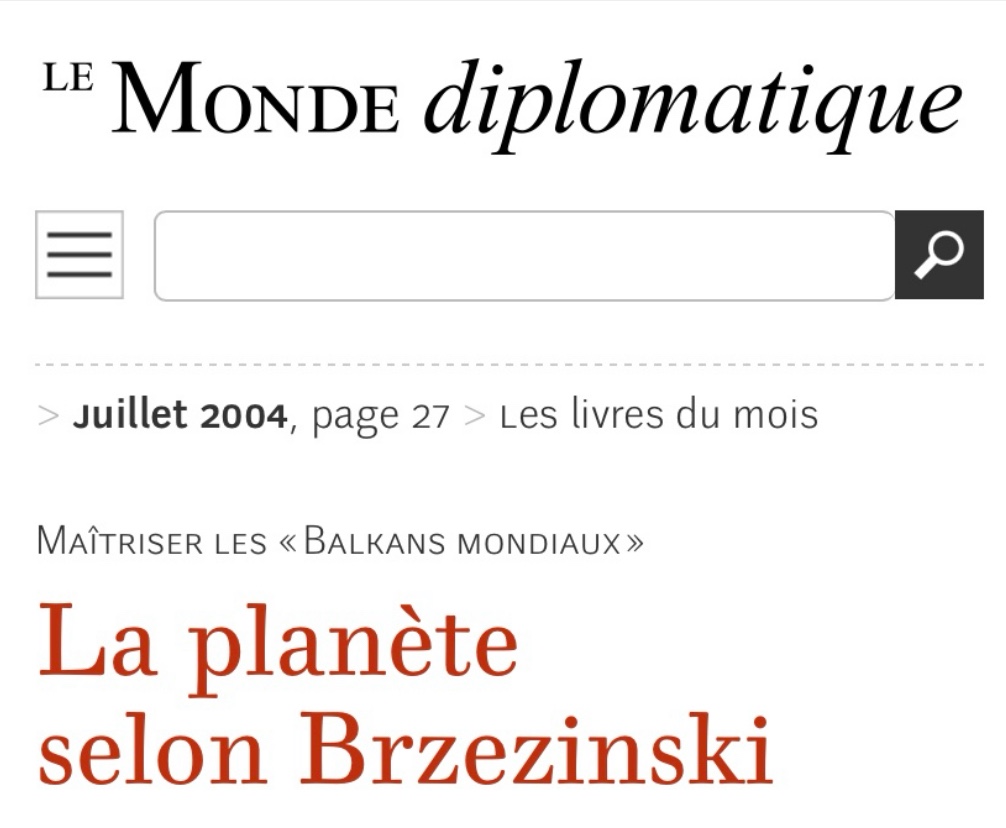
In its July 2004 edition, Le Monde diplomatique summarized this vision as follows:
A disoriented Russia would be definitively excluded from Ukraine, the Caucasus, and Central Asia, regions whose hydrocarbons would be exported outside its control. This would create a geopolitical balance more favorable to the West.
The republics of the North Caucasus, those small ethnic enclaves still under Russian influence, could be freed from Moscow’s domination.
Furthermore, the two Azerbaijans (the one from the former USSR and the one in Iran) could potentially be reunited.
This analysis reflects a Western strategy aimed at reducing Russian influence in its former Soviet space by promoting the integration of neighboring countries into the EU and NATO.
Le Monde diplomatique in July 2004 summarized the thinking of this American neoconservative as follows:
Poorly de-Sovietized, Russia should be definitively separated from Ukraine, pushed out of the Caucasus and Central Asia, whose hydrocarbons would be exported outside its control.
A weakened Moscow would result in a more favorable geopolitical balance.
The North Caucasian republics, this “constellation of small ethnic enclaves still under Russian domination,” could be liberated.
“The two Azerbaijans (former USSR and Iran) would be reunited.”
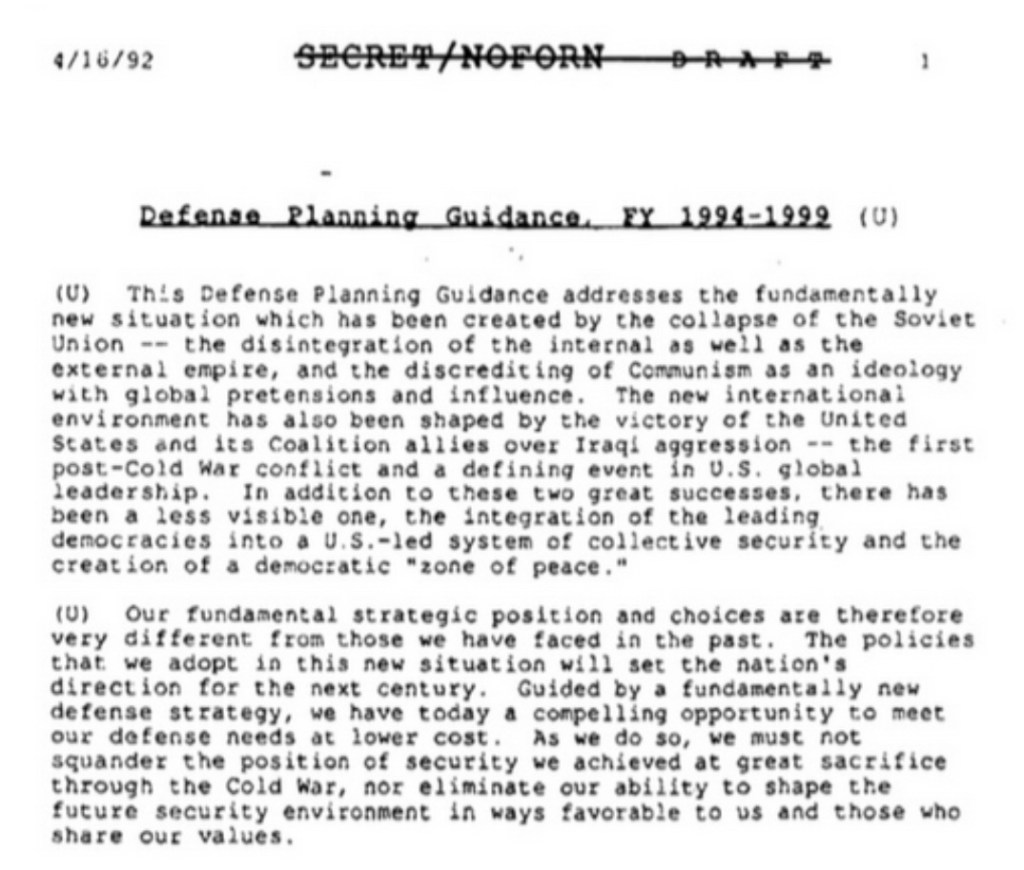
As early as 1992, the American strategy for Europe was as follows:
• Eastern enlargement of NATO and the European Economic Community (EEC)
• Work against too strong an integration of the twelve having the effect of compromising the integration of the Eastern countries.
• Prevent the twelve from setting up an autonomous European defense system.
The question of NATO’s eastward expansion is thus part of a long-standing agenda.
A declassified document dated February 9, 1990, records a promise made by U.S. Secretary of State James Baker to Soviet leader Mikhail Gorbachev during negotiations on German reunification:
« If we maintain a presence in a Germany that is a member of NATO, there will be no extension of NATO’s jurisdiction one inch to the east. »
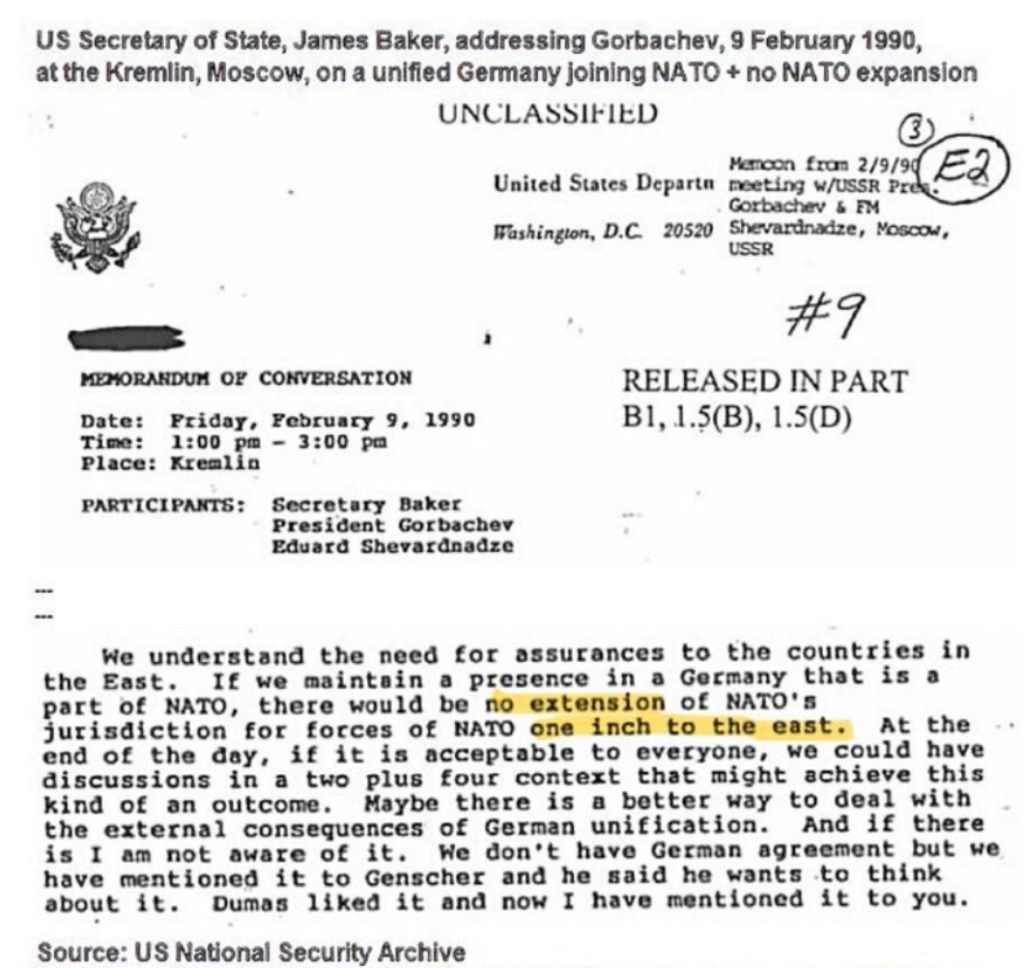
Although this assurance was not formalized in a treaty, it was perceived as a moral commitment by Russia, fueling accusations of « broken promises » in response to NATO’s subsequent expansion toward former Soviet bloc countries.
Indeed, on April 4, 2008, during the NATO-Russia Council session in Bucharest, Russian President Vladimir Putin strongly opposed NATO’s expansion, viewing it as a provocation aimed at paving the way for EU integration.
The Russo-Georgian War of August 2008, which broke out in the separatist regions of South Ossetia and Abkhazia, was a logical consequence of these tensions, although the conflict has deeper historical roots, particularly the strained relations between Russia and these regions, exacerbated by the pro-Western orientation of Georgian President Mikheil Saakashvili.
Ultimately, the Bucharest Summit, where NATO promised future enlargement to Ukraine and Georgia, acted as a catalyst.
Five years later, in 2013, the Commonwealth of Independent States (CIS), comprising 12 active former Soviet republics, aimed to transform into a customs union, modeled after the European Economic Community.
As Ukraine prepared to strengthen its economic ties with Russia, Ukrainian oligarchs, led by Petro Poroshenko, one of the country’s wealthiest individuals, advocated for an association agreement with the EU.
As Minister of Trade, Poroshenko negotiated this association project, described as the “most ambitious bilateral agreement” ever signed by the EU, which included a 99% reduction in customs duties.
The EU demanded that Ukraine choose between its Deep and Comprehensive Free Trade Area (DCFTA) and the customs union with Russia, presenting this decision as an exclusive choice between two geopolitical blocs.
Economically, Ukraine was facing a challenging year. For this reason, President Viktor Yanukovych requested €20 billion in annual aid from the EU, which offered only €610 million, conditional on reforms. French President François Hollande responded, “We are not going to pay Ukraine to sign the association agreement” (The Telegraph, 29/11/2013).
Thus, in 2013, Ukraine found itself facing a dilemma with dramatic consequences.
Vladimir Putin considered that “a Ukraine-EU free trade agreement would represent a major threat to Russia and lead to increased unemployment” and posed the question: “Must we strangle entire sectors of our economy so that Europe appreciates us?” (BBC, 26/11/2013).
Yanukovych proposed a trilateral agreement including Russia to avoid excluding either partner, but the EU, represented by Barroso, rejected this proposal, stating, “When we sign a bilateral agreement, we do not need a trilateral treaty.”
Finalement, la Russie offrit à l’Ukraine une aide de 15 milliards de dollars et une réduction du prix du gaz, formalisées dans un accord signé par Ianoukovytch le 17 décembre 2013. Cependant, Petro Porochenko et d’autres oligarques pro-UE poursuivirent une autre voie, plaidant pour l’intégration européenne.
Malheureusement l’histoire ne s’est pas arrêtée là. Porochenko en décida autrement.
A cet stade, il convient d’examiner la thèse selon laquelle, les EU et surtout les USA manipulèrent le pouvoir contestataire des Pro-UE et créèrent le mouvement EuroMaïdan financé en partie par le ministre oligarque, Petro Porochenko.
Le 7 février 2014, le Kyiv Post, un journal Ukrainien pro-occidental faisait état d’un sondage basé sur un échantillon représentatif de 2600 personnes, selon lequel 48 % ne souhaitaient pas de rapprochement entre l’Ukraine et l’Europe et ne soutenaient pas le mouvement « EuroMaïdan » contre 45 % des sondés qui supportaient les manifestations.

Coup d’État or Revolution?
When a government, supported by half the population and contested by the other half, is overthrown through the use of violence, should it be called a “revolution” or a “coup d’état”?
If the Yellow Vests in France had overthrown the government, would the international community have hailed it as a revolution?
The manipulation of protest movements, theorized during the Kosovo War in the 1990s, seems to have been repeated in Ukraine.
Euromaidan, fueled by both genuine popular discontent and external influences, led to a violent change of power, raising questions about the role of foreign actors in Ukraine’s destiny.
Viatcheslav Avioutskii, in his article “The Orange Revolution as a Geopolitical Phenomenon,” Hérodote, vol. 129, no. 2, 2008, pp. 69-99, writes the following about the so-called “Orange Revolution” of 2004:
“The opposition was able to rely on the support of Western NGOs and foundations ‘specialized’ in velvet revolutions, such as Freedom House and George Soros’s Open Society Institute, as well as American think tanks like the National Democratic Institute (NDI), affiliated with the Democratic Party, and the International Republican Institute (IRI), linked to the Republican Party.
These organizations had numerous local relays, among which the most significant was the student movement Pora. Beyond this indirect influence, the United States and the European Union used official channels to exert strong pressure to ensure the elections were conducted fairly. Polish President Aleksander Kwaśniewski and his Lithuanian counterpart Valdas Adamkus, accompanied by Javier Solana, were called upon to offer their mediation during the November 2004 crisis.”
He concludes: “It is undeniable that the campaigns organized by youth movements, such as Pora, have proven effective in the political transformation of the post-communist space.
They rely on activists trained and funded by NGOs and foundations, primarily American, which provide them with an intellectual framework, practical training, and significant financial and material resources.
These youth organizations, operating across borders and thus constituting transnational movements, challenge the principle of national sovereignty that previously dominated classical geopolitical analysis. The United States has proven to be a pioneer in this regard, though it does not hold a monopoly on this principle.”
The transcript below of an interview with George Soros by CNN demonstrates that the US has indeed never stopped acting on Ukrainian public opinion.
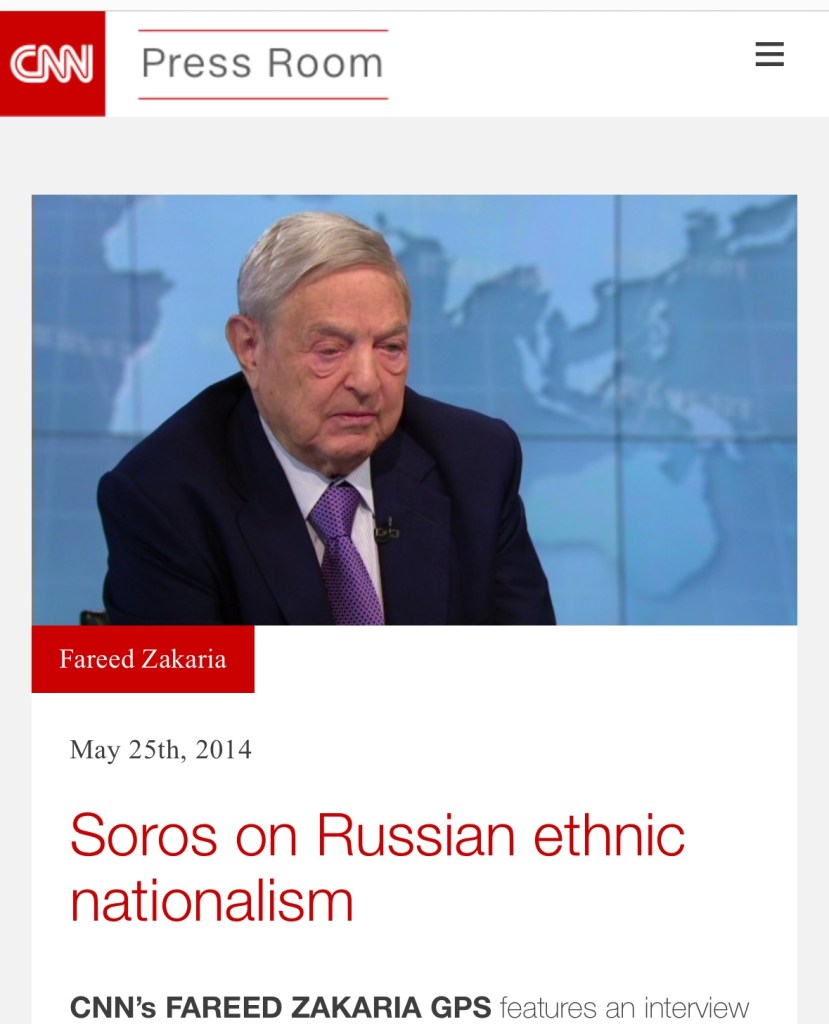
ZAKARIA : “ First on Ukraine. One of the things that many people have recognized about you is that you, during the revolutions of 1989, funded a lot of dissident activities, civil society groups in Eastern Europe and in Poland, in the Czech Republic.
Are you doing similar things in Ukraine? ”
SOROS : » Well, I created a foundation in Ukraine before Ukraine became independent from Russia.
And the foundation has been operating ever since.
And it has played a – an important role in the events now. » ( He is talking about the Maidan events).
Victoria Nuland , the famous American Under Secretary of State who famously said » Fuck the EU « , revealed on December 13, 2013 before the US-UKRAINE foundation that the United States had spent 5 billion dollars to help Ukrainians « satisfy » their « aspirations », namely to turn away from Russia to join the West.
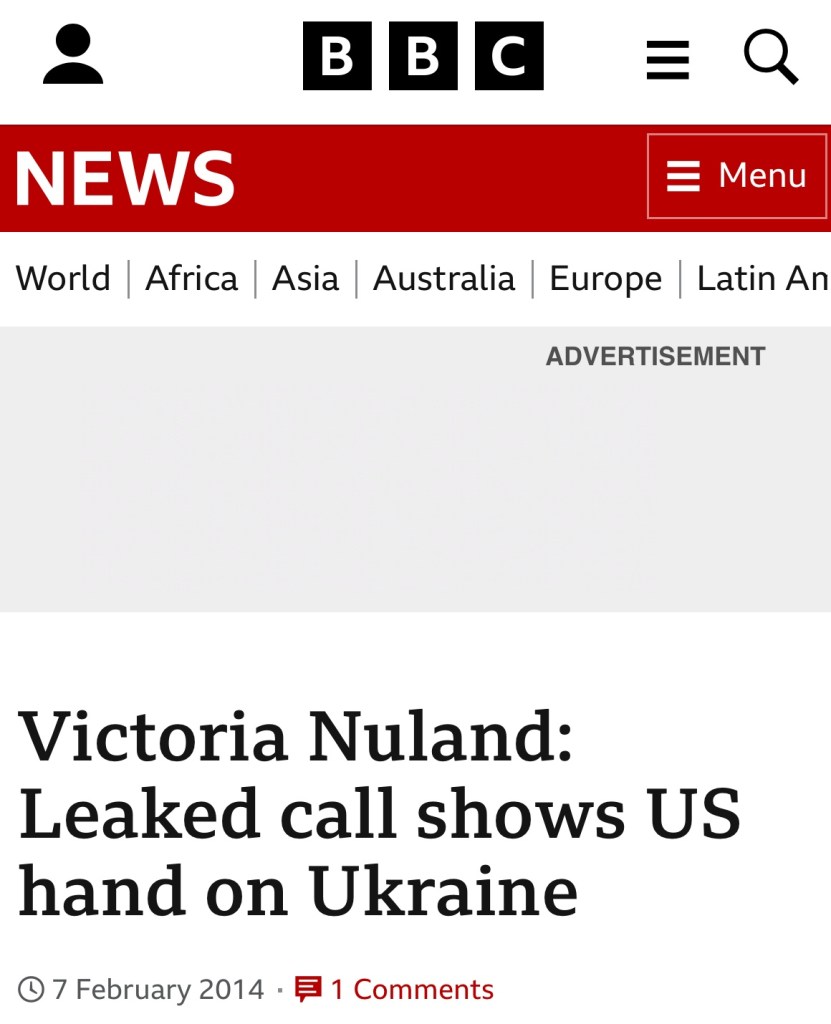
On February 7, 2014, BBC NEWS reproduced the transcript of a conversation between Victoria Nuland and the US Ambassador to Ukraine and headlined:
« Leaked Victoria Nuland phone conversation (with US ambassador to Ukraine) shows US stranglehold on Ukraine «
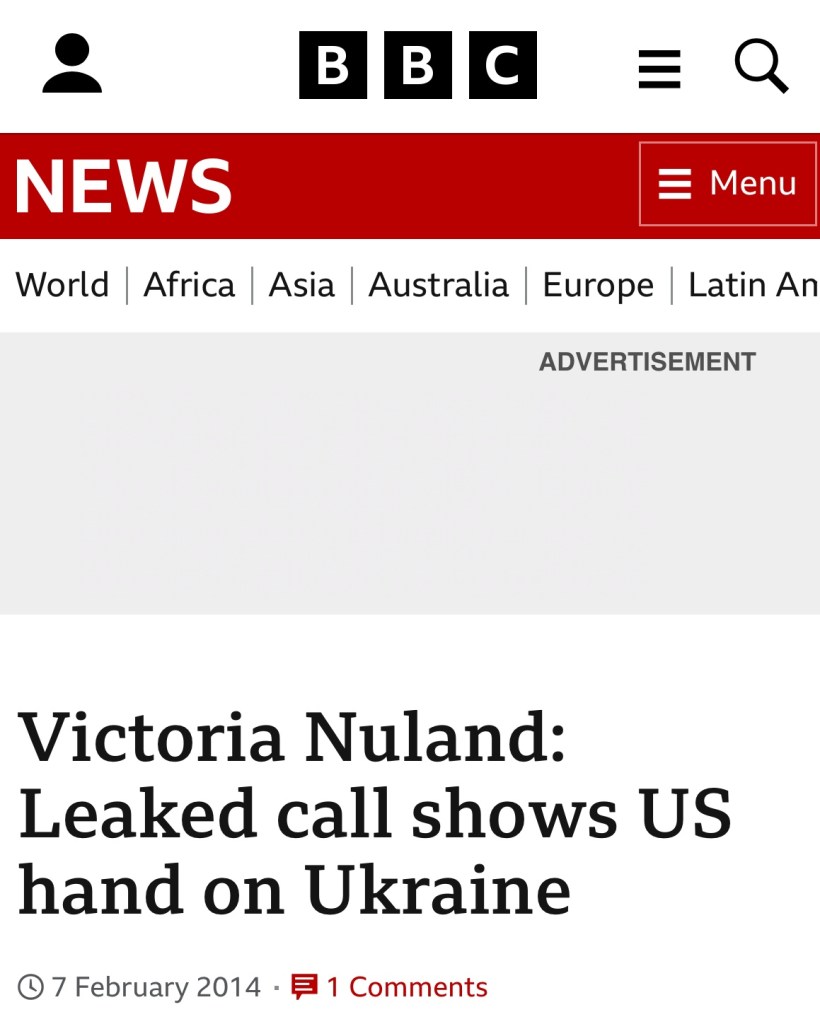
It features Victoria Nuland speaking with the US Ambassador to Ukraine and uttering her famous » Fuck the EU . »
The transcript of this conversation shows V. Nuland blocking a candidate for the post of Prime Minister and choosing her own candidate who will actually be designated Prime Minister thereafter.
Below is an excerpt from the famous transcript of V. Nuland ‘s conversation with the US ambassador to Ukraine ( Pyatt ):
Nuland : I don’t think Klitsch (current Kiev Mayor and former boxer Wladimir Klitschko) should enter the government, it’s not necessary, I don’t think it’s a good idea.
Pyatt : Yes. I guess… in that matter he doesn’t actually go into government, just let him stay out and do his political homework and everything.
I just think in terms of sort of the process moving forward, we want to keep moderate Democrats together.
The problem is going to be Tyahnybok [ Oleh Tyahnybok , the other opposition leader] and his guys and I’m sure that’s part of what [President Viktor] Yanukovych is calculating on all this .
Nuland : I think Lats ( Latseniouk ) is the guy who has the economic experience, the governance experience.
He is the… what he needs is Klitsch and Tyahnybok on the outside.
He has to talk to them four times a week, you know. I just think Klitsch coming in… he’s going to be at that level working for Yatseniuk , it’s just not going to work.
Pyatt : Yeah, no, I think that’s true. OK. Good. Do you want to set up a call with him as a next step?
Precisely, on February 27, 2014, five days after the dismissal of President Yanukovych, whose election had been certified by the OSCE, Latsenyuk was appointed Prime Minister.
Victoria Nuland, therefore, appoints the Ukrainian Prime Minister, at least 3 weeks before the supposedly « unpredictable » fall of the regularly elected president occurs.
Subsequently, people born abroad will be granted Ukrainian citizenship just hours before they take office so that they can join the new government.
The newspaper « Le Monde » reported the following on December 2, 2014:
» This team has a major surprise and something new: three foreigners are taking on top-level responsibilities.
The finance ministry is assigned to Natalia Iaresko, an American citizen of Ukrainian origin, who spent part of her career at the State Department, the American foreign ministry, before working in the private sector.
« where she will oversee a private equity fund created by the American government to invest in the country, and will be CEO of Horizon Capital, an investment company that manages various Western investments in the country.
A Lithuanian, Aïvaras Arbomavitchous , a former basketball champion but above all head of the Kiev branch of the East Capital investment fund, has been appointed to the economics department.
Finally, Sandro Kvitashvili , former Georgian Minister of Health and Labor, takes over the Ministry of Health, an important post given that the Ukrainian health system is undermined by corruption .
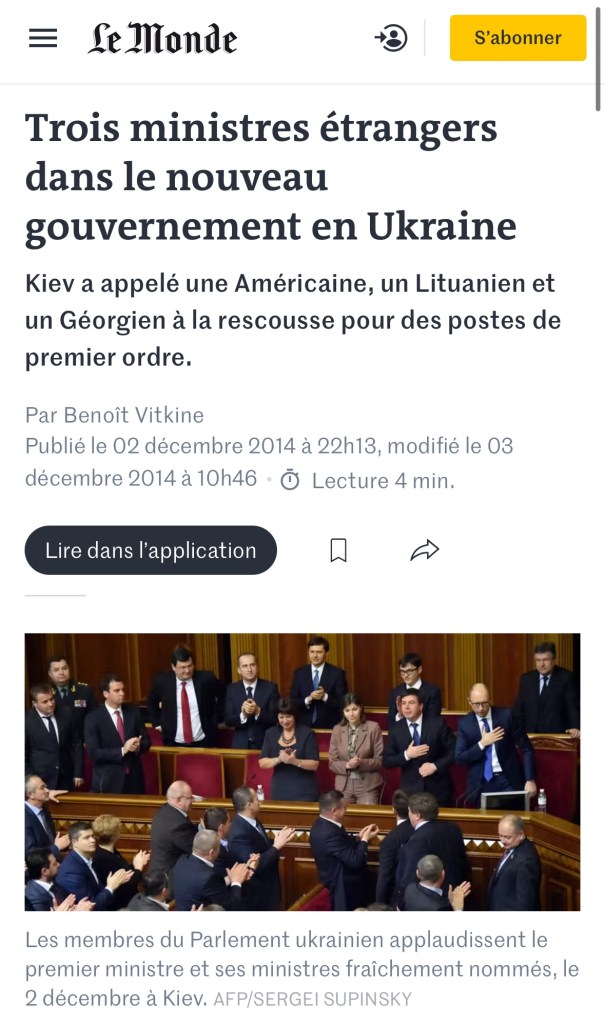
Le Monde continues : « These three explosive entries are an initiative of President Poroshenko, who has reserved for « foreigners », as the Ukrainian press already calls them, a part of the positions that belonged to his party.
The naturalization decrees were taken urgently on Tuesday. »
On the conversation between Nuland and the Ambassador, the BBC article will state: » The bulk of the conversation shows that the US is manipulating Ukraine as much as Russia is, and that is the real diplomatic disaster. »
What this recording reveals is that Victoria Nuland seems to consider that the fall of the sitting President is a foregone conclusion.
Such certainty could be explained either by an understanding of history and events, or more simply by the fact that a plan was drawn up for this purpose.
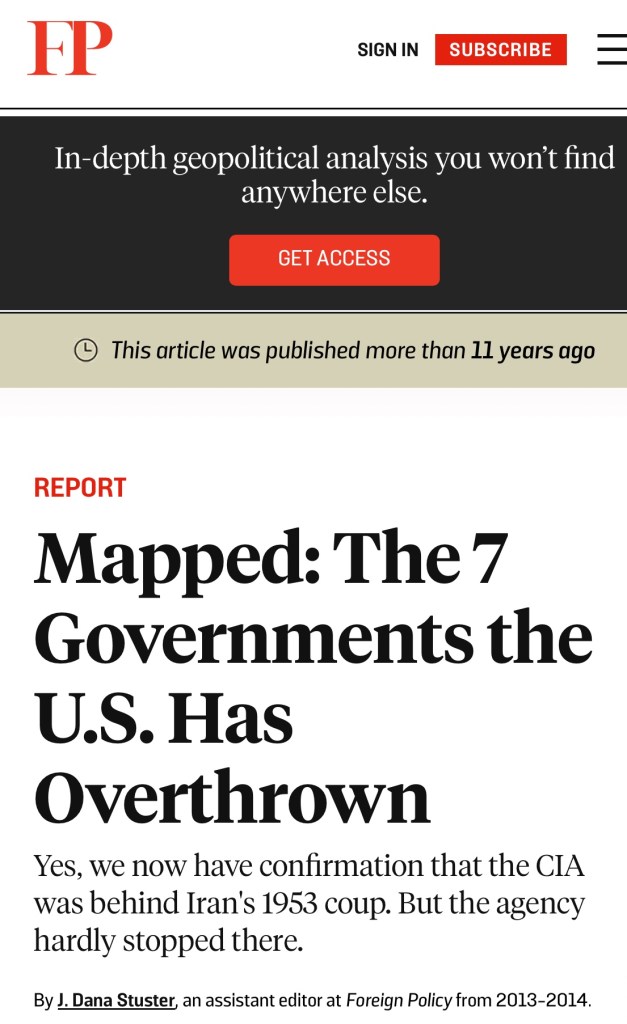
Those who might doubt that such a plan could have been envisaged and would be tempted to consider this hypothesis as conspiratorial, are certainly not familiar with the concept of » regime change » which has become a US specialty in support of which the » psychological operations » division is always mobilized.
On the practical application of US » regime change » techniques, the article below lists 7 foreign governments that were overthrown by means of operations carried out by the CIA.
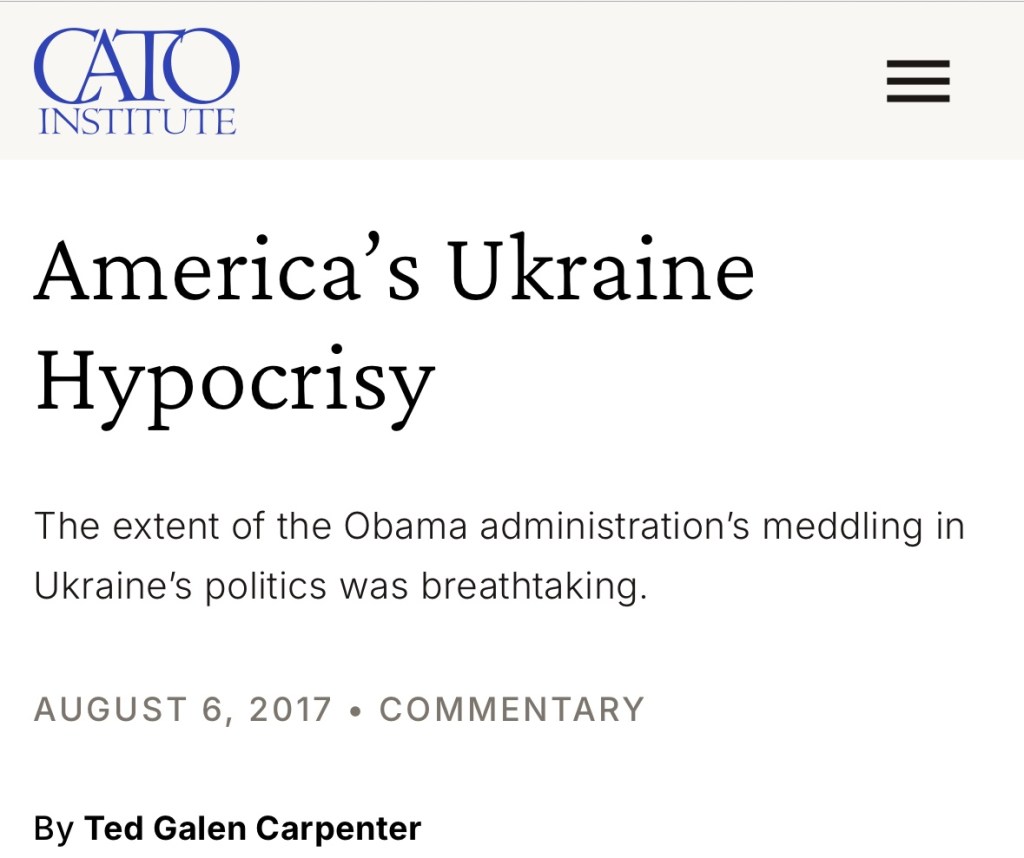
Looking back, the CATO INSTITUTE think tank stated in 2017 regarding the Maidan events of 2014:
“ The scale of the Obama administration’s interference in Ukrainian politics was breathtaking .”
A second element supports the theory of the orchestration of the coup d’état: the implementation of a » false flag » type operation .
In concrete terms, snipers fired on the crowd with live ammunition, causing the death of many demonstrators.
Public opinion considered that government forces were responsible for this massacre of civilians and that President Yanukovych himself had ordered the shooting of the crowd.
Not only was the international community outraged by the shooting of the crowd, but more importantly, Western Ukrainians who were not originally pro-EU switched to the pro-Euromaidan movement.
In the end, the Ukrainian president will be dismissed by the parliament, although the constitutional law did not allow it, and this without a vote of the elected deputies of his own party.
Since then, researchers have worked on the images, in particular a Ukrainian-Canadian researcher who describes his study as follows:
« This study analyses the revelations of the trial and investigation in Ukraine concerning the massacre that took place in Kiev on February 20, 2014.
This massacre of protesters and police on the Maidan led to the overthrow of Yanukovych’s government and ultimately to the Russian annexation of Crimea, the Russian civil war and military interventions in Donbass, as well as the conflicts between Ukraine and Russia and Western Russia that Russia aggravated by illegally invading Ukraine in 2022.
The absolute majority of the wounded Maidan protesters, almost 100 prosecution and defense witnesses, synchronized video and medical information, ballistic examinations conducted by government experts have unequivocally shown that the Maidan protesters were massacred by snipers located in buildings controlled by Maidan.
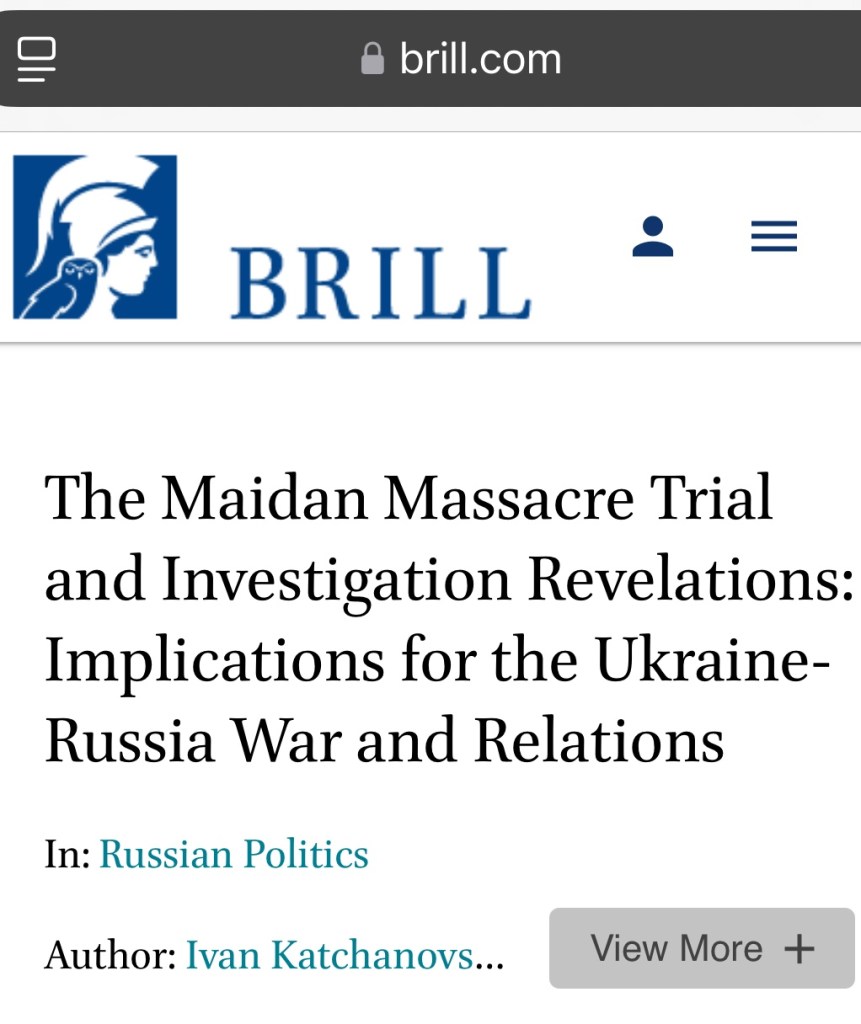
However, to date, due to the politically sensitive nature of these discoveries and the cover-up, no one has been convicted for the massacre.
The article discusses the implications of these revelations for the war between Ukraine and Russia and for the future of Russian-Ukrainian relations.
The conclusion of this researcher, who has struggled to establish himself but is now the subject of consensus, is that the shots fired at the crowd came from buildings controlled by pro -Maidans.
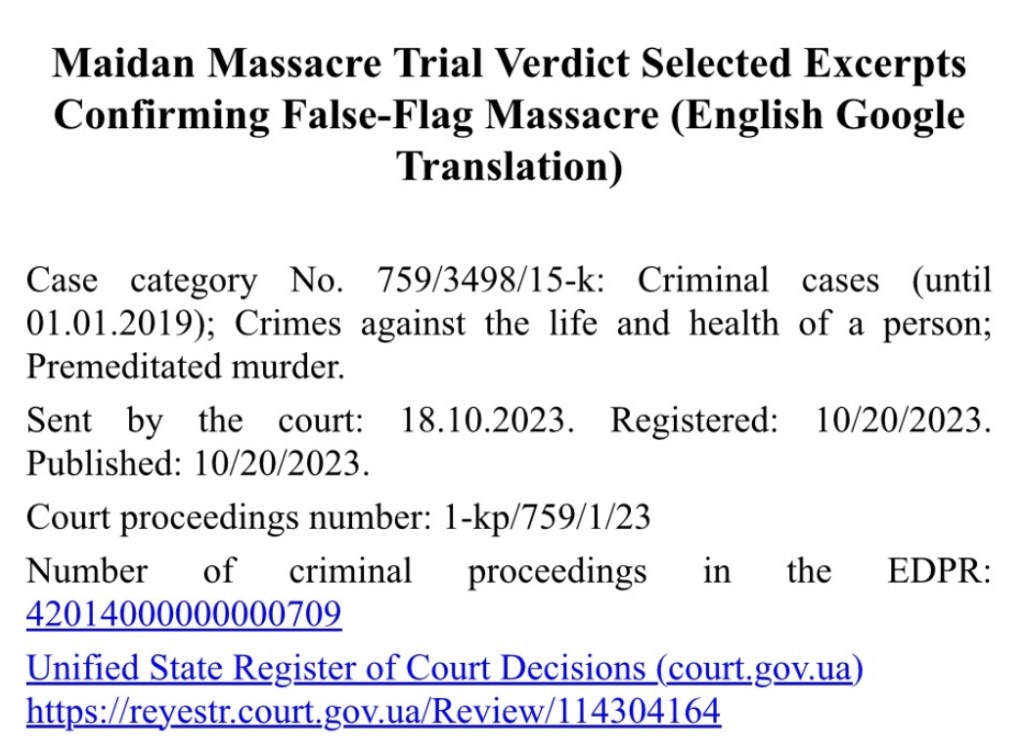
Thus, the reality of the « false flag » operation is reasonably established.
We can therefore speak of a real coup d’état, a » regime change » operation.
Did the US validate the » false flag » operation and participate in organizing the coup?
On the subject, we can say that the US has already considered this type of operation (« Operation Northwoods « , » TPAJAX « ).
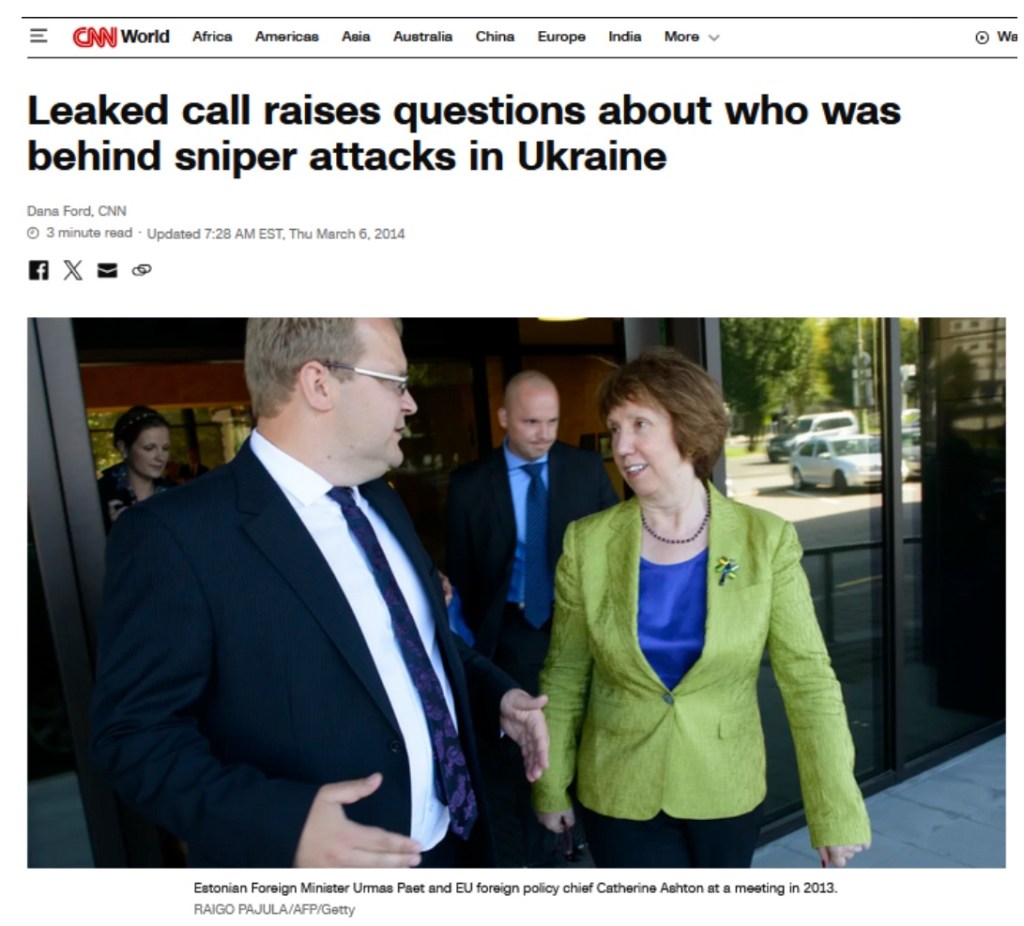
In 2014, a leaked phone call between EU foreign affairs chief Catherine Ashton and Estonian Foreign Minister Urmas Paetrevealed that they had discussed a possible false flag operation.
The 11-minute conversation was posted on YouTube.
In that call, Paet said he was told that the snipers responsible for the killings of police and civilians in Kiev last month were protest provocateurs rather than supporters of then-President Viktor Yanukovych.
Ashton replies: « I didn’t know… My God. »
« So there is a growing understanding that behind the snipers it was not Yanukovych, but someone from the new coalition, » Paet says .
Today, reading the above elements, it is therefore difficult to dismiss out of hand the hypothesis of a coup d’état orchestrated by the US or at least having received the assent of Washington.
There is absolutely no doubt about American interference. On December 15, 2013 , Senator McCain allowed himself to address the crowd of protesters directly.
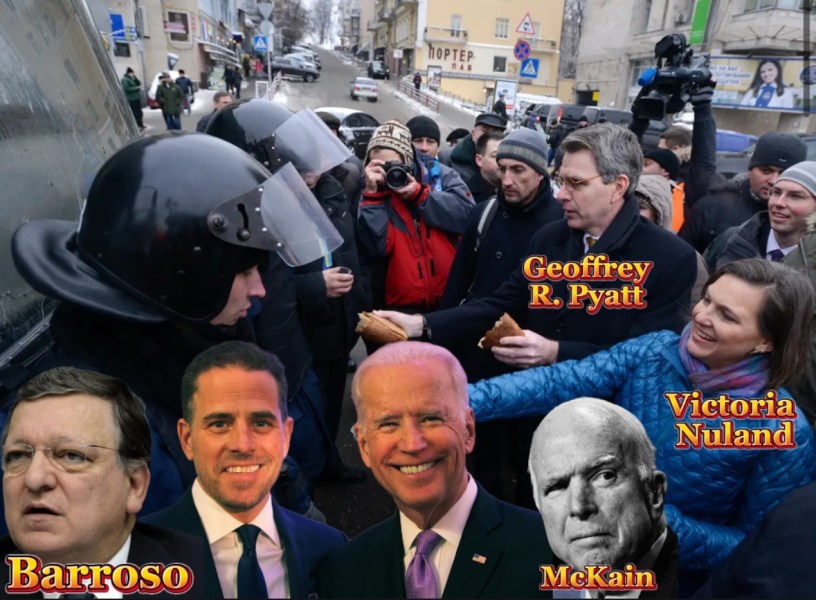
Four days earlier, Under Secretary of State Victoria Nuland handed out sandwiches to Protestants in the heart of Kiev, in the same way she might have done to the yellow vests who wanted to storm the Elysée Palace.
Today, retrospective analysis of the facts shows that without the effect of the violent groups that joined the crowd of demonstrators and without the effect produced by the false flag operation , the Ukrainian President would not have been deposed.
A few weeks before the fall of the President, Victoria Nuland proceeded as if it were irremediably a given, which tends to support the idea of a » regime change » operation orchestrated by the United States, especially since this type of operation was frequently practiced by the US.
As Politico reported in a February 21, 2014 article, » Ukrainian President Viktor Yanukovych and the three main opposition leaders signed an agreement brokered by the European Union and Russia to end the violence and prepare for a political transition . »
Thus, new elections were planned for December 2014, an amnesty for Protestants and the restoration of the 2014 constitution.
Among the three opponents who signed the European agreement were boxer Vitaly Klitschko , whom Victoria Nuland did not want as prime minister, and Arseniy Yatsenyuk , whom the Undersecretary of State had chosen for the post.
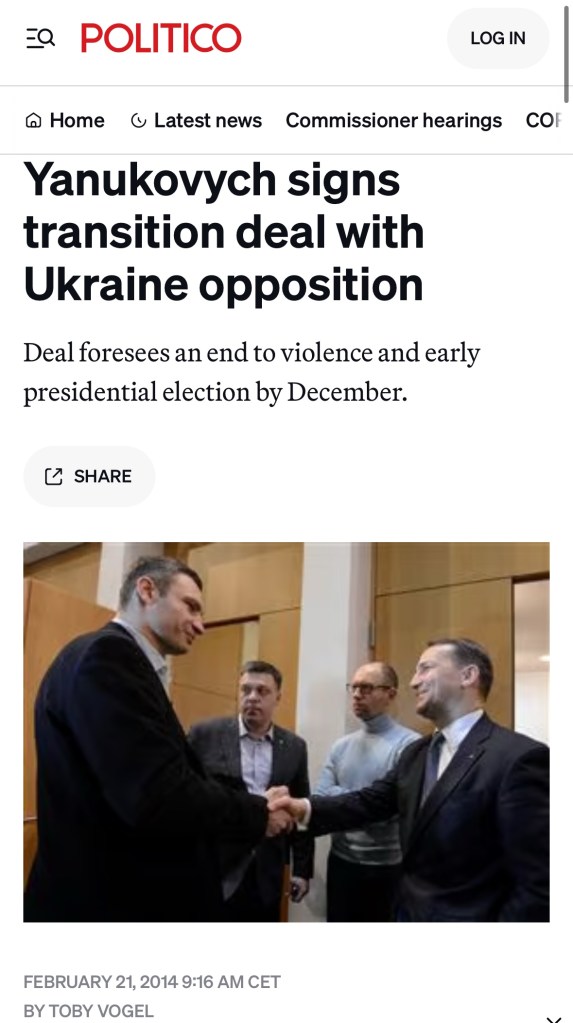
The third signatory was Oleh Tyahnybok , a notorious anti-Semite.
The day after this agreement, the duly elected President will be deposed and on February 27, 2014, five days after the President’s dismissal, Arseniy Yatsenyuk , in accordance with Victoria Nuland’s decision, will actually be appointed Prime Minister.
Senator McCain was also questioned at the end of 2013 by journalists after being photographed in the company of this ultra-nationalist, who wanted ethnicity to be required on passports, and who spoke of « Muscovites, Germans, kikes ( a pejorative term for Jews), and other scum who want to take over the Ukrainian nation. »
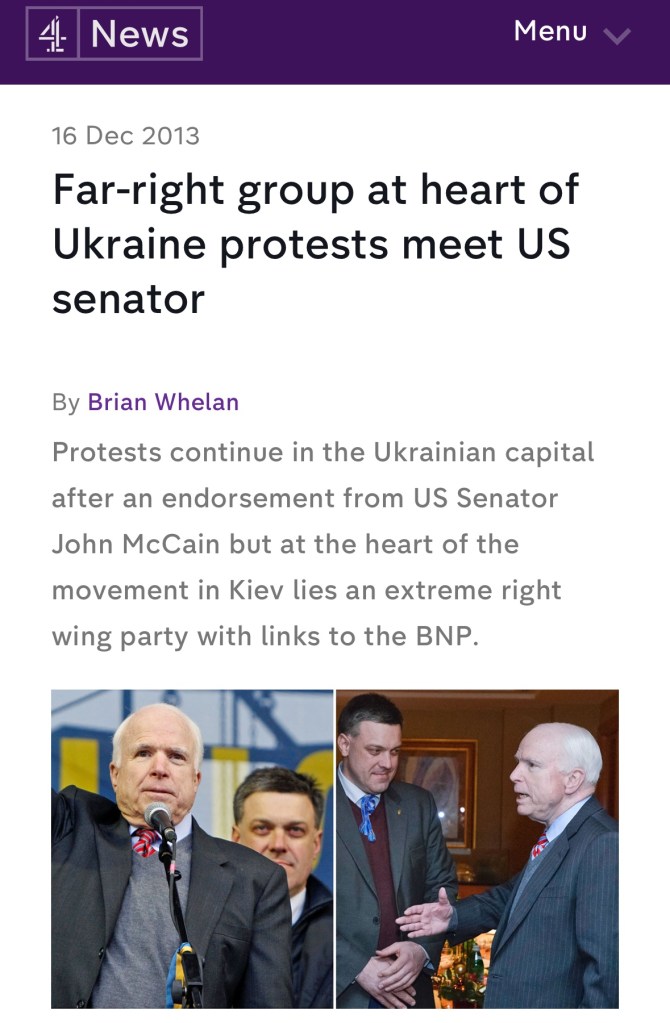
The rest is history.
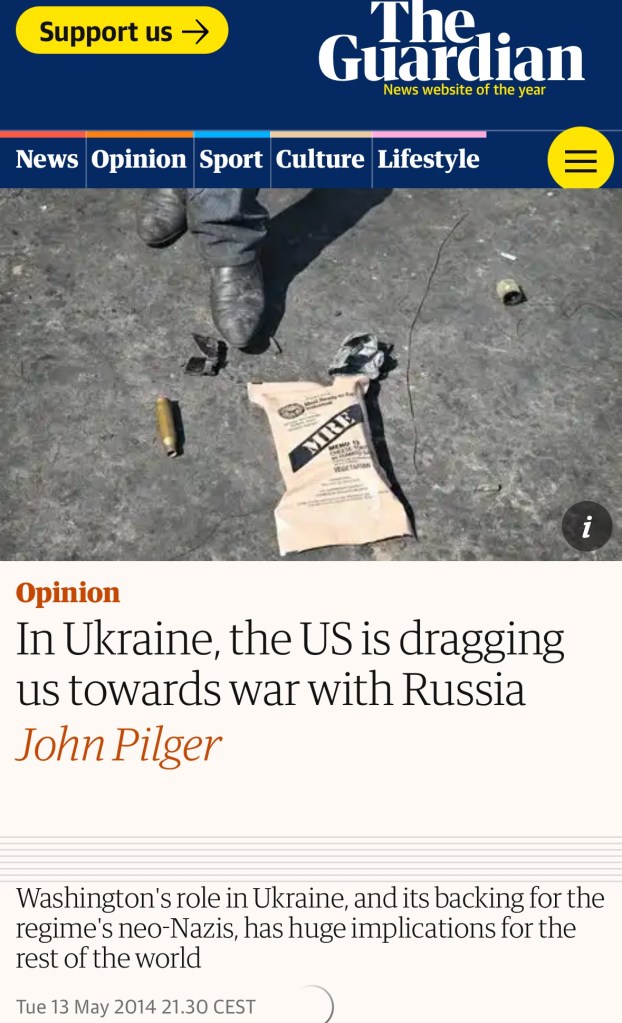
Some leading journalists had anticipated it as early as May 13, 2014, including John Pilger who wrote in The Guardian :
« in Ukraine the US is dragging us into a war against Russia »
On April 21, 2010, the newspaper « Le Figaro » reported that « in return for an agreement on the price of Russian gas, Ukraine is allowing Russia to establish its military presence on the Black Sea. »
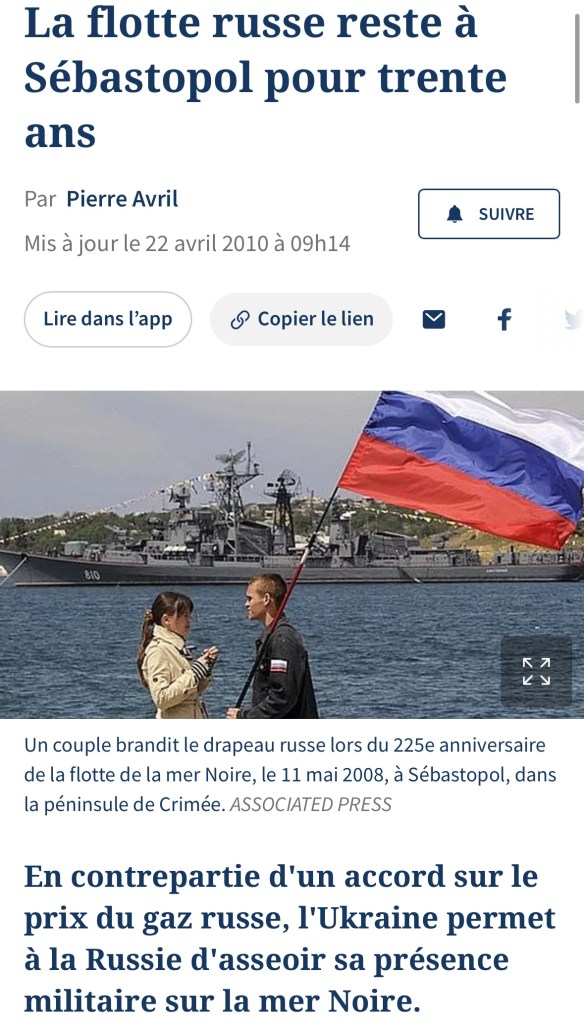
Knowing that Sevastopol has been home to the Russian, and later Soviet, Black Sea fleet since the end of the 18th century , one does not need to be a great strategist to understand that the Maidan coup and the agreements with NATO threatened the sustainability of this strategic naval base.
The annexation of Russian Crimea was therefore eminently predictable.
Reading these elements, it is difficult not to see the responsibility of the EU and the USin this conflict.
Reality exists and its examination demonstrates that European governance, neo-European expansionism, the greed of the European Commission, the intransigence of José Manuel Durao Barroso , of his donors, American interference are at the origin of the death of hundreds of thousands of Ukrainians and Russians.
On February 25, 2022 , the day after the Russian intervention, the National Endowment for Democracy ( NED) rushed to remove all traces of its actions in Ukraine.
A copy of the version of the NED website before the files were deleted is however available by clicking on the link below:
The lesson of all this is that the governance of the European Union, the ambitions of its expansionist policies and the aggressive tactics of American interventionism have tragically contributed to the current war and its devastating toll.
In conclusion, let us simply recall these words of the brilliant Karl Popper, visibly misunderstood by Georges SOROS:
« Rather than fighting for so-called higher values, politicians should be content to combat existing evils » and « reduce avoidable misfortunes. »
Excerpt from “ The Open Society and its Enemies ”
 Journal d'idées