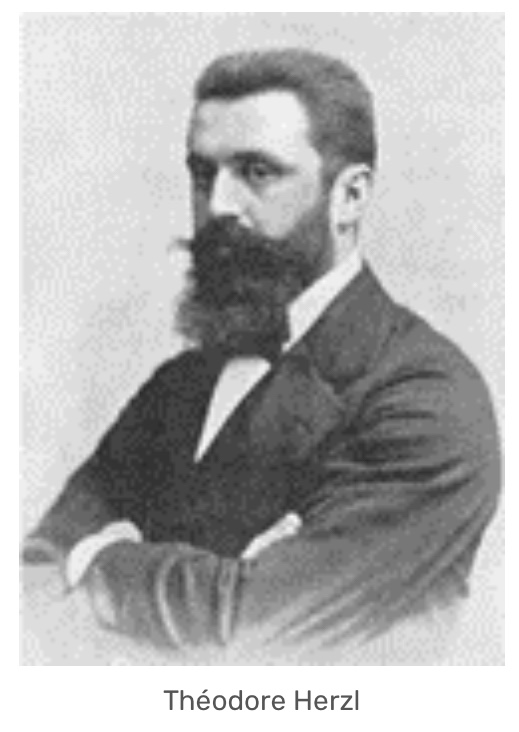
Today, being “anti-Zionist” makes no sense since the Zionist project as conceived by Theodor Herzl has already materialized and there is no question of calling into question the existence of state of Israel.
On the other hand, criticizing or even campaigning against religious neo-Zionism and encouraging the post-Zionist movement is a completely acceptable posture.
Post-Zionism vs. Neo-Zionism. Most people are not aware of the existence of this dichotomy.
This is regrettable, especially since without the application of the resulting distinctions, it is not possible to formulate in an intelligible manner the problems that Jewish and Arab Israelis face.
Based on this observation, I undertook the writing of this short article aimed at enlightening the reader on the debates taking place in Israel.
I will therefore review several themes in a multidisciplinary framework. I will address the religious, political, legal aspects as well as the question of beliefs and representations, without practicing double standards or teleological interpretation.
My only goal is to produce meaning and accuracy.
I – THE CONCEPTION OF A JEWISH ETHNO-RELIGIOUS IDENTITY AND ITS CONSEQUENCES
According to Alain Dieckhoff, “with the advent of Israel, Zionism achieved its main objective”, the state of Israel being conceived as the instrument which allowed “the gathering of the exiles”.
Since the acquisition of this sovereignty, the question of Israel’s identity, its values and its ideals has continued to arise.
This is why Israel does not have a constitution.
In France and in most countries, what establishes the nation state is the feeling of sharing a system of values and principles, which are most often included in the constitution.
As for the religious criterion, even if it is often used in Arab countries which incorporate it into their constitutions, it remains incompatible with the principle of neutrality.
Finally, the ethno-cultural criterion has a negative connotation because it establishes distinctions based on real or fantasized race.
A few years ago, I spoke with a former academic, a spider specialist, with whom I had become friends.
During our discussions, the latter sometimes mentioned her Jewish ancestry.
She explained to me that she felt troubled because she was not a believer, therefore not Jewish in the religious sense of the term, and yet she always felt caught up, in spite of herself, by a Jewish identity that she represented with regret, as engraved in his being without her consent.
For Christians and Muslims, this type of problem does not arise. In application of Aristotle’s principle of non-contradiction, a Christian cannot be Christian and non-Christian at the same time.
However, there are non-Jewish Jews, the Jewish identity claiming to merge two domains, that of ethnicity and that of religion.
One signifier for two signified objets and confusion sets in.
The difficulty is that the fusion between the ethno-cultural on the one hand, and the Jewish religion itself, on the other hand, is desired by the neo-Zionists.
Today, there are Christian Arabs, Muslim Arabs, French Muslims, Belgian Jews… There are Arab Jews, which is to say Jews who live in Arab-Muslim cultural areas, but are there Jewish Arabs?
Can an Arab convert to Judaism? Let’s imagine this were possible, would we call this person a Jewish Arab?
Shouldn’t we create a term to define a person who is a follower of rabbinic Judaism regardless of their ethnocultural origins?
For example, imagine a Peul from Senegal officially converted to Judaism. What terms could we use instead of the phrase “Jewish Peul”?
Finally, the association « Jewish French » does not pose a problem since the term « French » refers to nationality which itself refers to the concept of nation « à la Renan » and not to an ethno-religious character which in this association is attached exclusively to the word “Jew”.
The association “Jewish Arab” is more complex since the each of the two words composing this expression have an ethno-cultural and/or ethno-religious connotation which collide and do not assimilate.
As everyone knows, most states grant status based on nationality to their nationals, but according to the Israeli Supreme Court, there is no such thing as Israeli nationality. Only citizenship exists, it being specified that birth certificates differentiate Jewish citizens and Arab citizens.
Everyone will easily understand that the concept of an Israeli nationality is perceived by certain political and religious currents as a scarecrow because it would be likely to merge the Jewish and Arab communities into a single Israeli community.
However, Jewish ethno-religiosity is for some, in particular for the neo-Zionist sphere, the main foundation of the state of Israel, which prevails over the democratic ideals and justice claimed by post-Zionist currents and by Israeli Arabs.
Question: Is it appropriate to talk about a Jewish state, even though there are non-Jewish, atheist, Muslim or Christian Israeli citizens?
At this stage, everyone will have understood why until now no constitution has been able to see the light of day in Israel.
There is indeed a lack of consensus on the definition of the State of Israel since the dialectic between the democratic and justice ideals dear to the post-Zionists and the ethno-religious criterion endorsed by the neo-Zionists has not been able to achieve a synthesis.
In our opinion, the search for a conciliation between these two visions of the state of Israel is vain because intrinsically, it is not possible.
Only the inclusion of religious neutrality in Israeli fundamental laws would be likely to promote the democratic ideal and justice.
II – JUSTICE AND NATIONALISM THROUGH THE TEXTS
« I hate, I reject your celebrations, I do not approve of the perfume offered in your assemblies.
If you offer me your burnt offerings and your oblations, I take no pleasure in them, and I do not regard the fat animals that you sacrifice.
Take away from me the sound of your songs; let me not hear the sound of your harps!
Let judgment flow like water and justice like a constant stream! »
(AMOS 5.21-24)
This very harsh and demanding text fits perfectly into the major themes of Hebrew prophecy which run through the books of the prophets (Nevi’im).
Let justice flow “like a constant stream.” Thus, the quest for justice is a sacred mission, which God, through the voice of the prophets, has entrusted to Israel.
This thirst for justice is found in the words of André Néher, writer, Franco-Israeli philosopher, honorary rabbi, specialist in Hebrew prophetism, who expressed himself in these terms: “Perish the Jewish community… Perish the State of Israel if this community were to be unjust, if this State were to be unjust! It is indifferent to me to know that there is a survival of the Jewish people if the Jewish people become the acolytes and accomplices of evildoers, criminals who have spread throughout the world.«
After the 6-day war, when Emmanuel Levinas reminded him of his comments, André Néher replied: “Yes, I maintain it, but Israel is on the side of justice. « .
Alongside this ideal, a Jewish nationalism coexists which sometimes compromises this justice demanded by Elohim.
The gospel also bears traces of this nationalist pride through the words attributed by Matthew to John:
“And do not dare say within yourselves, “Our father is Abraham.” For I tell you, from these stones God is able to raise up children for Abraham. (Matthew 3-9).
When we read between the lines, we understand that the writer of this text seems to be struggling with a form of pride based on the supposed primacy of blood ties.
“Our father is Abraham” proudly declare the Pharisees, to which they are told in a colorful manner that blood ties are worth nothing since even stones can produce Abraham children and thus authentic followers of the Jewish religion.
What determines Jewishness would therefore not be biological, descent, but rather the state of mind and in particular the attachment to the justice desired by God.
2000 years later, this nationalism based on Abrahamic filiation has not disappeared since the analysis of the Israeli legal system and in particular that of the 14th fundamental law confirms that the ethnic criterion (blood ties) and the religious criterion remain in a fused state.
- La persistance d’un filtre ethnique informel au sein des institutions sécuritaires rwandaises : entre discours officiel d’« ethnic amnesia » et réalité du pouvoir
- Documentation Guerre Rwanda-M23 contre RDC (2025-2026)
- Islams, hadith-mania, narrative Pokémons, Mohammed and Jean-Sol Partre…

 Journal d'idées